
NEWS
Hormuz Strikes Keep Resetting the UAE Beach Calendar
Each new Strait of Hormuz tanker strike resets beach access on the UAE northern coast and Oman’s Musandam, even after Ras Al Khaimah reopenings.

Oil from tankers hit in the Strait of Hormuz is still reaching UAE sand, and each new strike puts beach access back on local notices. Dubai and Abu Dhabi have recorded no beach spills. Ras Al Khaimah, Umm Al Quwain, Sharjah’s Gulf coast, Khor Fakkan, and Oman’s Musandam peninsula now sell a winter season that can close after the next fire.
The U.S.-Iran war began on Feb. 28. The tourism slump is in its ninth month. The new cost is operational: a coast that reopens, then shuts, then reopens somewhere else, because the strait is still a shooting gallery.
The Gem No. 2 Slick Closed Three Emirates
The worst hit on UAE sand so far came from the Panama-flagged tanker Gem No. 2, struck on Oct. 9 about 13 nautical miles west of Al Jazeera. A fire broke out and was later put out. The Indian consulate in Dubai said all 22 Indian crew members were rescued. Crude kept leaking for weeks.
Satellite images showed a slick more than 22 miles (35 km) long. Residents reported a strong fuel smell. The Ministry of Climate Change and Environment confirmed the spill on Oct. 22. On Oct. 23, authorities closed all public beaches in Ras Al Khaimah and Umm Al Quwain, and on Sharjah’s Gulf coast, and told fishermen to stay out of the affected water. UAE officials said on Oct. 30 that the leak at the ship had been stopped and that pollution density had fallen, while cleanup continued.
The ministry did not name the tanker in public. Shipping records and satellite matches did. That gap, from the Oct. 9 strike to the Oct. 22 confirmation, is now part of how this coast is sold. Guests can smell oil before an official notice exists.
THE GEM NO. 2 CLOCK
- October 9, 2026: Gem No. 2 is struck about 13 nautical miles west of Al Jazeera, and a fire is later extinguished.
- October 22, 2026: The Ministry of Climate Change and Environment confirms a spill after residents report a fuel-like smell.
- October 23, 2026: Public beaches close in Ras Al Khaimah, Umm Al Quwain, and on Sharjah’s Gulf coast; fishermen are told to avoid the area.
- October 30, 2026: UAE authorities say the leak at the tanker has been stopped and that marine pollution density has declined.
- November 9, 2026: Khor Fakkan closes Al Luluyah Beach after oil slicks on the Gulf of Oman, the first confirmed spill on the UAE east coast.
- November 11, 2026: Ras Al Khaimah reopens seven public and resort beaches; most Umm Al Quwain and Sharjah Gulf beaches stay shut.
Coastal scientists say there is no fixed number of days after a cleanup when a beach is safe. Heavily oiled habitats can take decades to recover. A reopening is a local judgment, not a reset of the water.
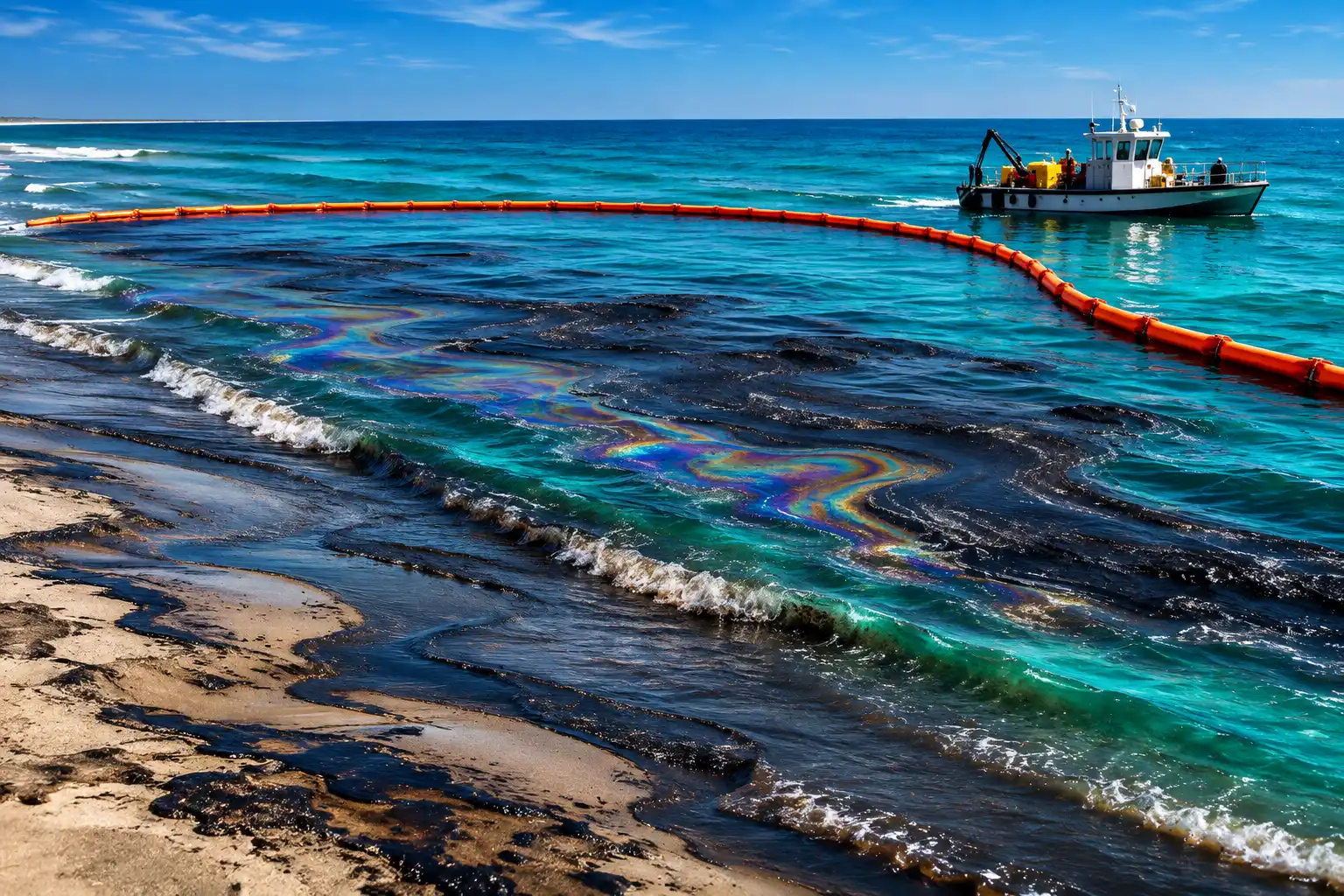
Khor Fakkan Shut While Ras Al Khaimah Reopened
The east coast did not wait for the Gulf-side cleanup. On Nov. 9, Khor Fakkan Municipality closed Al Luluyah Beach after oil slicks, raised red flags, and told people to stay out of the water. Officials did not name a source. UK Maritime Trade Operations had logged an incident about 18 nautical miles east of Khor Fakkan involving a bulk carrier and military forces, and said the environmental impact was unknown.
Khor Fakkan sits on the Gulf of Oman, not the Arabian Gulf, and has been a wartime container outlet while Jebel Ali traffic stayed constrained. Oil on that sand is oil on the bypass. Two days later, the Ras Al Khaimah Government Media Office said seven public and hotel beaches were safe to visit after cleanup. Most beaches in Umm Al Quwain and Sharjah stayed closed. The stretch from Sharjah to Ras Al Khaimah had been shut for nearly three weeks.
BEACH STATUS BY COAST
| Coast | Action | Date |
|---|---|---|
| Ras Al Khaimah, Umm Al Quwain, Sharjah Gulf | All public beaches closed | Oct. 23 |
| Khor Fakkan, Gulf of Oman | Al Luluyah Beach closed | Nov. 9 |
| Ras Al Khaimah | Seven public and resort beaches reopened | Nov. 11 |
| Umm Al Quwain and Sharjah Gulf | Most beaches still closed | After Nov. 11 |
| Dubai and Abu Dhabi | No beach spills reported | Through Nov. 20 |
The seven Ras Al Khaimah sites named by the government media office were Flamingo Beach, Dahan Beach, Al Mairid Beach, Al Rams Corniche, and the beaches at Anantara Mina Al Arab, InterContinental Ras Al Khaimah Mina Al Arab, and The Cove Rotana. Officials said more would reopen when ready. That promise now sits next to a strait where ships keep catching fire.
The UAE draws most of its drinking water from coastal desalination plants, and much of its port and factory plant sits on the same shore. Hotel sand is the visible closure. Intake pipes are the quieter one. After the Umm Al Quwain landfall, the question that followed the beach video was whether Quwain and Sharjah plants had taken a hit. The ministry has not published a plant-by-plant account in the material reviewed for this story.
Why Musandam Divers Are Watching Notices in Khasab
Oman’s Musandam peninsula is the other product tied to the strait. Its walls, pinnacles, and khor fjords are the finest diving on the Arabian Peninsula, and the cool season from October through March is when visibility is best and scalloped hammerheads show at Lima Rock. That window is also the window in which tankers are being hit a few miles off Khasab.
In late September, Ahmed Al Dhuhuri, owner of the Musandam safari boat The Vision, said life and tourism were still running. His boats were going out on weekends, and he had not seen oil at the dive sites he was then using. Bookings had already slumped when the war began, he said, because guests were spooked by attacks in the region. That was before the November hits sat seven and eight nautical miles north of town.
MUSANDAM’S WINTER PRODUCT
- Peak water: October through March, with water at about 22 to 25C and visibility often 15 to 25 meters.
- Headline animal: Scalloped hammerheads at Lima Rock and the outer walls, most reliable from November through February.
- On-land bet: The governorate is pushing a $1.6 billion tourism drive, with 13 hotels that took in about RO 11.66 million this year and 18 cruise calls in the first quarter carrying 30,950 visitors.
A liveaboard can still leave Khasab on a clear morning. What it cannot sell is certainty that the next projectile, or the next mine claim, will not put a burning LPG carrier in the same water. On Nov. 16, UKMTO reported a tanker attacked about seven nautical miles north of Khasab, with an engine-room fire. On Nov. 17 the same ship, identified by India’s ports minister as Tara Gas, was hit again. Omani authorities took off 24 of 25 crew. One Indian seafarer remained missing. India’s embassy in Muscat said it was working with Omani officials on the rescue.
Dubai Lost Guests Without Oil on the Sand
Dubai’s problem is still the war, not tar on Jumeirah. CoStar’s STR put Dubai hotel occupancy at 68.4% in October, down 16.5 points from 84.9% a year earlier. Ras Al Khaimah fell 16.4 points to 71.5% from 87.9%. Those October figures cover the month when the northern Gulf beaches were closed. Ras Al Khaimah International Airport expects full-year passenger traffic up to 28% below 2025.
OCTOBER HOTEL AND AIRPORT SNAPSHOT
- Dubai rooms: Occupancy 68.4% in October, down 16.5 points from 84.9% a year earlier, per CoStar’s STR.
- Ras Al Khaimah rooms: Occupancy 71.5% in October, down 16.4 points from 87.9%.
- Ras Al Khaimah airport: Full-year passenger traffic expected up to 28% below 2025.
- Clean sand split: No spills reported on Dubai or Abu Dhabi beaches through Nov. 20.
The northern emirates already leaned on UAE weekend trips after European arrivals collapsed in the spring. A staycation guest can drive from Dubai to Ras Al Khaimah in a morning, look at a local notice, and turn around. An international diver who booked Lima Rock in November cannot. That is the split Dubai does not yet carry: war fear in the reservation system, plus oil in the actual product.
Shipping through the strait is still a fraction of what it was. Kpler, in a Nov. 13 briefing using flows to Nov. 11, put Strait of Hormuz transits at 5,660 kbd, about 33% of the pre-war 17,148 kbd, and 11 tanker crossings a day against 50 before the war. Total Hormuz Clearance, including Gulf of Oman ship-to-ship exports, averaged 8,264 kbd, or 48% of the pre-war mark. Red Sea volumes ran at 4,436 kbd, 58% above the pre-war 2,804 kbd, as more barrels skipped the strait. That reroute now shares the map with Houthi pressure on the Bab al-Mandeb. ADNOC Logistics and Services said a vessel in its fleet was damaged in UAE territorial waters on Nov. 10. Kpler’s note was blunt: ships were coming under attack almost daily around the strait.
Buried Oil From 1991 Still Marks Saudi Shores
The Gulf has done this before, at a larger scale, and the recovery clock is the reason a second slick this year is not a second cleanup. The 1991 war release left an estimated 0.9 to 1.9 million barrels of oil on Saudi intertidal shores and hit about 640 km of coastline. Early monitoring into 1995 found lower-shore species diversity back near unpolluted sites. Later surveys were harsher.
Field work in 2002 and 2003 found buried oil under sand and under microbial mats, plus tarcrete pavements. Those surveys, summarised in a 90 percent of sand beaches still-impacted reading against clean control shores, also left mangroves, marshes, flats, and rock below control diversity. Recovery times were pushed out to more than a century for marshes without tidal flushing.
WHAT 2002-2003 SURVEYS STILL FOUND ON SAUDI SHORES
- Mangroves: 64% remained impacted, with lower diversity than control shores.
- Salt marshes: 70% remained impacted; unflushed marshes were later judged to need more than a century.
- Tidal flats: 88% remained impacted.
- Sand beaches and rocky shores: 90% of each remained impacted.
UAE crews on the Gem No. 2 shore are working through the same shoreline clean-up techniques used after ship-source spills worldwide. ITOPF notes that most of those spills happen close to the coast, and that the wrong method can add damage. A hotel beach can be raked and reopened. A mangrove, a seagrass bed, or a khor wall cannot be put back on a November booking window.
Greenpeace Counted More Than 609 Slicks Since February
Greenpeace Middle East and North Africa, working from satellite monitoring with maritime tracking firm Kpler, put the ledger in a Nov. 19 statement. It found about 148 vessels attacked across the Gulf region and more than 609 possible oil slicks across the Gulf, the Strait of Hormuz, and the Arabian Sea since February, with cumulative daily mapped footprints of about 21,000 km². The map runs along much of the UAE Gulf coast, through the strait, and down Oman as far as Muscat.
The greatest danger is that this becomes the new normal. Each new spill risks hitting ecosystems that have not recovered from the last. Communities across the Gulf should not have to pay the price of this conflict with their health, livelihoods and environment.
Ghiwa Nakat, Executive Director, Greenpeace MENA, Nov. 19, 2026
That is the booking problem in one line. Ras Al Khaimah can declare seven beaches safe. It cannot declare the next tanker. On Oct. 26, more than two weeks after Gem No. 2 was hit and after dispersants had been used, crude still blackened stretches of Umm Al Quwain’s Old Town and Al Sinniyah Island even as slicks at sea looked thinner than they had two days earlier. A reopening on Nov. 11 does not unwind that residue, and it does not cover Al Luluyah.
The Next Strike Is Already the Booking Problem
Iran’s Revolutionary Guard navy said on Nov. 17 that a supertanker carrying more than 2 million barrels of crude and an LNG carrier exploded after hitting mines in the strait, and Iran’s army said a third tanker was damaged east of the waterway. Those mine claims were not independently verified. UKMTO did confirm fires and projectile reports in the same stretch of water, including Tara Gas off Khasab. The source of the Khor Fakkan slick has not been named. The volume lost from Gem No. 2 has not been published.
On Nov. 20, UKMTO said an outbound tanker was struck by an unknown projectile eight nautical miles north of Khasab, with a fire on the port bow. It reported no casualties and no environmental impact. The Guard navy said an offending tanker had hit a mine on a route Iran had not permitted. Same water, two stories, one coast that has to decide whether the beach flag stays red.
The same day, Musandam’s official winter-season account posted photos of a children’s festival in Khasab. Eight nautical miles north, a tanker was on fire. That is the product on offer this winter: a notice that can change with the next strike, on a shore that has not finished with the last one.

Jeeno Thitikul Passes Annika on Three $4 Million Checks

Cohen Locks Skubal for $450 Million With No Opt-Outs

TCU Fires Sonny Dykes Seven Months After Extending Him

BepiColombo Reaches Mercury After a Shortened Capture Burn

Andromeda’s Bao Merger Times How Binary Stars Tighten

Warsh Rejects Rate Guidance and Still Moves Markets

Davina McCall Reveals Cardiovascular Disease After Cholesterol Warnings

Dana-Farber Exits an MGB Medicare Advantage Network Early

NASA Launches the Roman Space Telescope’s Cosmic Bet

OpenAI’s Cyber Letter Puts the Defense Bill on Governments
-
 BUSINESS3 months ago
Warsh Rejects Rate Guidance and Still Moves Markets
-
 ENTERTAINMENT1 month ago
Davina McCall Reveals Cardiovascular Disease After Cholesterol Warnings
-
 BUSINESS2 months ago
Dana-Farber Exits an MGB Medicare Advantage Network Early
-
 NEWS3 months ago
NASA Launches the Roman Space Telescope’s Cosmic Bet
-
 NEWS3 months ago
OpenAI’s Cyber Letter Puts the Defense Bill on Governments
-

 NEWS3 months ago
Russia Recycles Its Old Warning Over Storm Shadow Plants
-

 ENTERTAINMENT2 months ago
Primetime’s $2.7 Million Preview Tops Pitt’s Costlier Film
-
 BUSINESS3 months ago
Jet Drones Lock Down Kyiv and Strip Kherson of Heat