
BUSINESS
India Holds the US Trade Deal for a Peer Tariff Edge
India’s first US trade slice is in legal drafting, yet New Delhi will start it only after a tariff edge over rival exporters, with a Russia-oil duty still open.

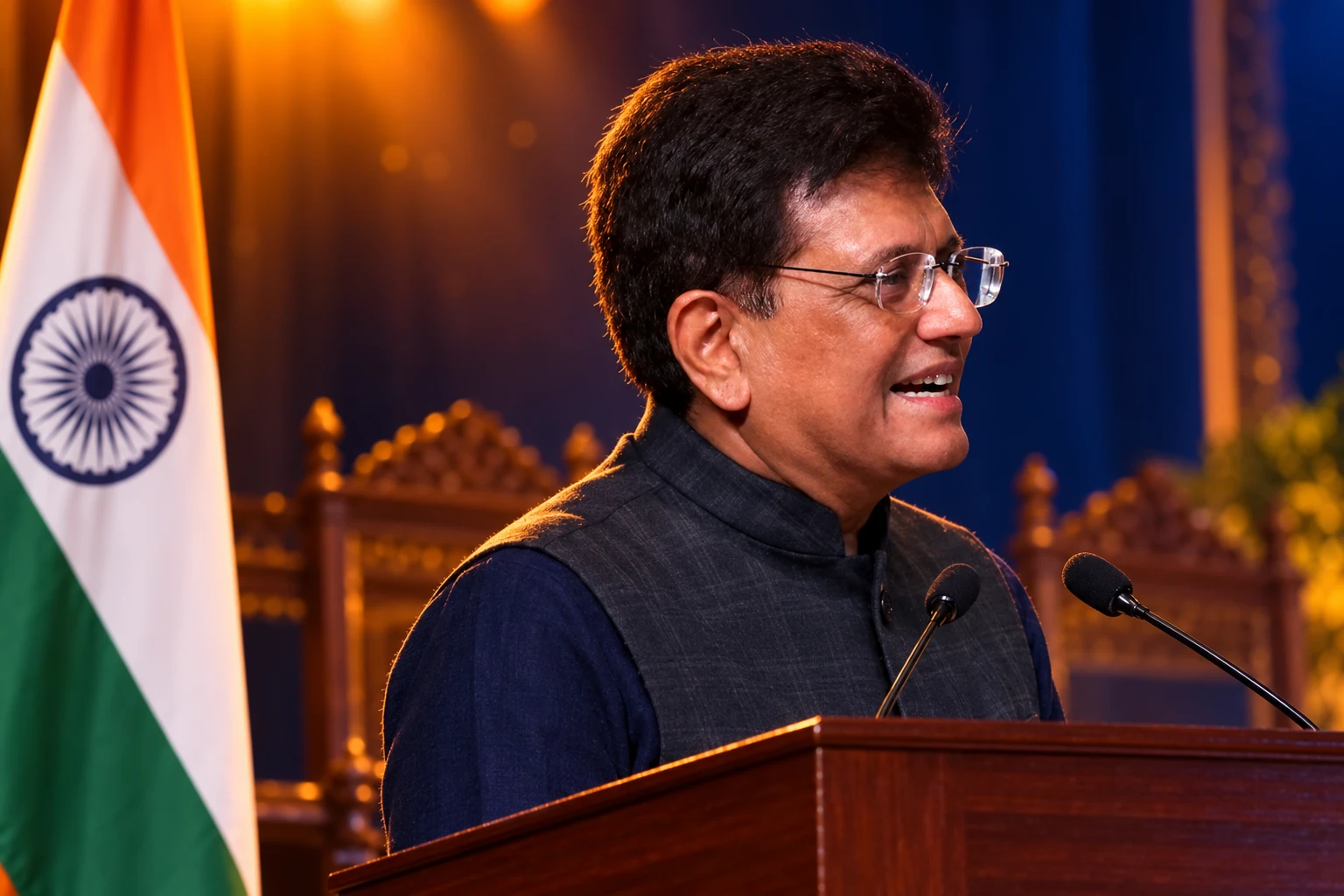
Commerce Minister Piyush Goyal said on October 15 the first tranche of the India-US trade deal is in legal drafting. He told a Delhi college audience it will start only after India beats peer exporters on US tariffs.
Commerce Secretary Rajesh Agrawal said signing still waits on Washington’s wider tariff rewrite after a US Supreme Court ruling, and on how that map treats India’s rivals. US Ambassador Sergio Gor said the big items are done and that lawyers are rewriting a pact whose old tax hook is gone.
The First Tranche Goes to the Lawyers
Goyal spoke at the Shri Ram College of Commerce centenary conclave. He said the first slice of the two-country pact has been settled in talks and is now in its last legal shape.
The US bilateral trade agreement first tranche has been finalised. It’s going through final contours, the legal drafting, and we hope to be able to finalise that soon and operationalise that once we get comparable advantage or competitive advantage over our peer countries.
Piyush Goyal, Commerce and Industry Minister, SRCC Centenary Conclave, New Delhi
He added that the line was the same one he had used the day before, a week earlier, and three months earlier. On October 9 he had already put the test in public: the basic element of the deal, he wrote, is how it will give India a comparative advantage.
The basic element of the India-US Trade deal is how it will give India a comparative advantage. pic.twitter.com/ptdwdPvr1O
— Piyush Goyal (@PiyushGoyal) October 9, 2026
Agrawal, briefing reporters on monthly trade figures the same day, said both sides were “in a very good zone” and hoped to close and sign “at the earliest possible time.” He did not give a date. US Trade Representative Jamieson Greer said earlier in October that the two sides had named the remaining sticking points and that a deal was not imminent.
Finance Minister Nirmala Sitharaman said on October 5 that talks looked as if they had reached a plateau, with little room left for fresh concessions. Thursday’s legal-drafting claim moves the paper. It does not lift Goyal’s peer-rate hold.
Why India Will Not Switch the Deal On Yet
Agrawal was blunt about what “finalised” still is not. A trade pact, he said, has to give Indian goods better access than competitors get in the same US market. That better rate, he said, “will come as a part of the new tariff framework that the US is working on.”
Signing, he said, will track that rewrite and “some of the outcomes under (Section) 301,” at a time both sides agree. External Affairs Minister S. Jaishankar, speaking on October 14 at a New Delhi forum, called the same split: one part is what India and the United States work out with each other, and one part is how India fares against other economies that have not all struck deals. His sense, he said, was that the file was heading toward a “landing point.”
Gor, at the same forum on October 15, said he would leave details to ministers and that “in the grand scheme of things, big items are done.” He said the two sides were “very close to landing it.” He also said India and the United States are complex places with “tens of thousands of points to figure out,” and that matching them will not happen overnight.
The first tranche is a goods pact. It does not, on the public record, reopen the H-1B fee hike or the tighter green-card track that has hit Indian IT firms. Those fights run on a separate rail.
The Supreme Court Knocked Out the Old Tariff Hook
The hold is not only political. The February text was written around a US tax that the courts then killed, so the lawyers are drafting against a different statute.
On February 6, the White House and India issued a framework for an Interim Agreement. It sat on Executive Order 14257, the reciprocal-tariff order from April 2, 2025. A White House fact sheet on February 9 said the United States would lower the Reciprocal Tariff on India from 25% to 18% on that plan. The extra 25 percent duty tied to Russian oil purchases had already been pulled on February 7.
On February 20, the Supreme Court held in Learning Resources, Inc. v. Trump that the emergency-powers law used for those country tariffs does not authorise tariffs. Collection of the IEEPA duties stopped on February 24. A 10 percent surcharge under Section 122 of the Trade Act of 1974 then ran 150 days and lapsed on July 24.
As you know, we had a trade deal. The trade deal was offsetting. You had higher tariffs that then were offset by a trade deal. The Supreme Court had ruled that law unconstitutional. So the administration has had to go back and rework some of those things.
Sergio Gor, US Ambassador to India, New Delhi forum, October 15, 2026
What a US buyer of most Indian goods pays now is the normal duty for the product line plus a 10 percent Section 301 add-on that began on July 24. The February 18 percent rate was never published as a live customs line. As of October 5, no signed interim text had been posted by USTR or the White House.
THE TARIFF STACK ON INDIAN GOODS
- August 7, 2025: India’s reciprocal IEEPA rate is set at 25 percent.
- August 27, 2025: A further 25 percent IEEPA duty tied to Russian oil takes most goods to a combined 50 percent on top of the normal duty.
- February 6, 2026: The two governments publish the interim-agreement plan, including an 18 percent reciprocal rate.
- February 20 to 24, 2026: The Supreme Court ruling lands; IEEPA tariff collection ends; the 10 percent Section 122 surcharge begins.
- July 24, 2026: The surcharge expires. A 10 percent Section 301 duty on products of India begins, with listed exemptions.
Talks on a broader Bilateral Trade Agreement were launched by President Donald Trump and Prime Minister Narendra Modi on February 13, 2025. Gor called the pace “about a year and a half” and “almost an unheard-of pace” next to the nearly 20 years of India-EU talks, which were concluded in January and which Goyal said would be signed in December and take effect in February or March 2027.
Peer Exporters India Is Trying to Outrank
Goyal’s go-live test is a ranking, not a handshake. On the live Section 301 add-on, India is already cheaper than Vietnam and China and is tied with Bangladesh, Cambodia, Indonesia and Mexico.
USTR’s July 23 action imposed 10 percent Section 301 duties on 17 economies that ban forced-labour imports, promised such a ban in a reciprocal trade pact, or run a partial regime. India was in the higher 12.5 percent bucket in the June proposal and was moved down after USTR credited a forced-labour import ban. Vietnam, China, Thailand and Brazil stay at 12.5 percent. The action covers 60 economies and, USTR said, 99.4 percent of US imports.
SECTION 301 ADD-ON BY PEER ORIGIN
| Origin | Extra Section 301 rate | Gap versus India |
|---|---|---|
| India | 10 percent | Baseline |
| Bangladesh | 10 percent | Tied |
| Cambodia | 10 percent | Tied |
| Indonesia | 10 percent | Tied |
| Mexico | 10 percent | Tied |
| Vietnam | 12.5 percent | India 2.5 points lower |
| China | 12.5 percent | India 2.5 points lower |
That 2.5 point gap versus Vietnam is not the “preferential market access with their competitors” Agrawal described. India shares the 10 percent bucket with the garment exporters it actually fights for US orders. Goyal has said India wants the same US-yarn and US-cotton garment facility Bangladesh already has, with no quota on those cotton imports. The February plan also promised, once the interim text was concluded, to drop the reciprocal tariff on generic medicines, gems and diamonds, and aircraft parts, and to give India a tariff-rate quota on auto parts.
In July the commerce ministry said about 45 percent of India’s US-bound goods sit outside the extra 10 percent duty, including shipments already under Section 232 and many finished medicines. The other 55 percent pay the add-on. Steel, aluminium and other 232 goods pay their own, higher, metal rates instead.
US-Bound Goods Rose Without a Signed Pact
The US stayed India’s largest goods-export market in the first half of the current fiscal year, even with the extra duty in force from late July.
INDIA-US GOODS TRADE, APRIL-SEPTEMBER 2026
- Exports to the US: $50.81 billion, up 11.1 percent from $45.73 billion a year earlier, commerce ministry data released on October 15 show.
- Imports from the US: $32.33 billion, up 26 percent from $25.66 billion.
- Goods surplus: $18.48 billion, down from $20.07 billion, as US sales into India grew faster than Indian sales the other way.
For the full year to March 2026, Indian goods exports to the US were $87.3 billion, up 0.92 percent, while imports were $52.9 billion, up 15.95 percent. The surplus fell to $34.4 billion from $40.89 billion. Gor said two-way trade, goods plus services, is now “eclipsing $250 billion,” against less than a tenth of that 20 years ago.
The February joint statement still lists what India offered in return. New Delhi said it would cut or drop tariffs on all US industrial goods and on a wide farm list that includes dried distillers’ grains, red sorghum for feed, tree nuts, fresh and processed fruit, soybean oil, and wine and spirits. It also said India intends to buy $500 billion of US energy products, aircraft and parts, precious metals, technology goods and coking coal over five years, and to take more GPUs and other data-centre kit. Those purchase lines are political commitments in a plan, not customs entries.
Labour-heavy lines are the ones that live or die on the peer ranking. Textiles, leather, footwear, plastics, organic chemicals, home décor and some machinery were named for the 18 percent reciprocal rate in February. Gems, generic drugs and aircraft parts were named for a later zero on that reciprocal layer, if the interim text ever took effect. None of those cuts is in the Harmonized Tariff Schedule today.
A 100 Percent Oil Tariff Is Still on the Table
A second US clock is running beside the lawyers. On September 18 Trump signed the Lindsey O. Graham Sanctioning Russia and Iran Act of 2026, which lets him put tariffs of up to 100 percent on major buyers of Russian oil and gas. The duties are not automatic.
Gor said on October 15 that Trump was expected to decide “within the next 10 or so days,” and that the aim was to cut funds for Russia’s war, not to punish any one country. “I don’t think he expects anyone to overnight turn off their lights,” Gor said. Asked about relief for India, he said the call rests with the president. Agrawal said India hoped for more clarity when the trade pact is signed, and that New Delhi wants “more tariff stability and trade stability as a part of the deal.”
India’s goods imports from Russia rose to $47.29 billion in April-September 2026 from $31.12 billion a year earlier, according to the same commerce ministry release. That bill is why exporters still treat a “finalised” first tranche as a draft. Goyal’s comparative-advantage test is six days older than Thursday’s legal-drafting line, and the oil-tariff vote is why a finished text can still sit unlit.
WHAT WE KNOW
- The paper: Goyal says the first tranche is in legal drafting; Agrawal says signing waits on the US tariff rewrite and Section 301 outcomes.
- The live duty: Most Indian goods pay the normal US rate plus 10 percent Section 301 as of July 24; the February 18 percent IEEPA rate is not in force.
- The H1 score: US-bound goods rose to $50.81 billion in April-September 2026, and the US remained India’s top goods-export market.
WHAT IS UNCONFIRMED
- A signing date: No mutually agreed date has been announced; Greer said earlier in October a deal was not imminent.
- The instrument: Whether the drafted text restores an 18 percent reciprocal rate, widens zeros for aligned partners, or only restates the 10 percent 301 map.
- The oil vote: Whether India is carved out of, or hit by, the Graham Act tariffs of up to 100 percent.
Gor said he had sat in rounds with Greer and Goyal that had already reached product lines and tariff percentages. New items, he said, keep appearing because technology moves. The range of open points, Agrawal said, has narrowed over time.
Rubio’s Mumbai Stop Centers on Energy Talks
The next cabinet-level American in India is not billed as a signing trip. The State Department said on October 13 that Secretary of State Marco Rubio will travel to Mumbai and Jamnagar from October 17-22, after a stop in Samarkand. The note says he will meet senior Indian officials on the strategic partnership, regional issues and energy, and will see business leaders on investment. It does not mention the trade text.
Jamnagar is home to Reliance Industries’ refinery. Energy is also the live fight in Washington, where the Graham Act clock is running. Gor said the embassy had, within three weeks of his arrival, announced the February trade plan. The plan is the document now being rewritten so that, if Goyal holds his line, Indian garments, gems and leather face a lower US tax than the same crates from Dhaka or Ho Chi Minh City.
Until that ranking is in the US tariff map, the first tranche can be finished in legal language and still sit in a drawer. Agrawal’s test is simple, and it is not a date: better access than the peers, then a mutually agreed signing, then the switch.

Ken Urker’s Accidental Overdose Leaves His Finders Waiting

A Third Carrier Arrives as Hormuz Tankers Keep Burning

Shoe Prices Hit a Record as Flagship Pairs Stay Put

Nvidia’s First Call Without Huang Tests the Money Machine

Blake Griffin Says Oklahoma City Taxpayers Bought a Thunder Arena

Warsh Rejects Rate Guidance and Still Moves Markets

Davina McCall Reveals Cardiovascular Disease After Cholesterol Warnings

Dana-Farber Exits an MGB Medicare Advantage Network Early

NASA Launches the Roman Space Telescope’s Cosmic Bet

OpenAI’s Cyber Letter Puts the Defense Bill on Governments
-
 BUSINESS3 months ago
Warsh Rejects Rate Guidance and Still Moves Markets
-
 ENTERTAINMENT1 month ago
Davina McCall Reveals Cardiovascular Disease After Cholesterol Warnings
-
 BUSINESS2 months ago
Dana-Farber Exits an MGB Medicare Advantage Network Early
-
 NEWS3 months ago
NASA Launches the Roman Space Telescope’s Cosmic Bet
-
 NEWS3 months ago
OpenAI’s Cyber Letter Puts the Defense Bill on Governments
-

 NEWS3 months ago
Russia Recycles Its Old Warning Over Storm Shadow Plants
-

 ENTERTAINMENT2 months ago
Primetime’s $2.7 Million Preview Tops Pitt’s Costlier Film
-

 BUSINESS3 months ago
Jet Drones Lock Down Kyiv and Strip Kherson of Heat