
BUSINESS
Goldman Frames the 2027 AI Impulse Peak as a Handoff
Goldman Sachs says the AI investment impulse peaks in 2027, a bigger test for stocks than growth, as credit already prices the boom’s funding bill.

Goldman Sachs expects the boost from AI investment to peak in 2027, a harder test for stock markets than for the U.S. economy. Kamakshya Trivedi, the bank’s head of global FX, rates and emerging-market strategy, put that call among 10 investment themes for 2027, even as the dollar amount of spending is still rising.
The Impulse Peaks While Spending Keeps Climbing
The word that matters in Trivedi’s note is impulse, the extra push to growth, not the cash still being poured into chips, halls, and power. On November 12, Goldman Sachs forecast annualized spending on AI-related hardware and intellectual property would climb to $1.4 trillion by the end of 2027, equivalent to nearly 4% of the U.S. economy, and would already exceed $900 billion by the end of 2026.
That is a year-end run rate, and it is still going up. “AI will remain the dominant driver of business investment growth in 2027,” the bank said in that economics note, putting quarterly U.S. business-investment growth at 8%, nearly double the 4.2% consensus. Democrats’ gains in the midterm elections, it added, pose only limited risk to the buildout.
Jan Hatzius, Goldman’s chief economist, had already drawn the distinction on October 26. He wrote that the growth impulse from the AI boom was set to peak in late 2026 or early 2027, “even before concerns around the sustainability of the AI investment boom intensified in recent weeks.” Investment is still rising fast, he said, but its increase as a share of GDP should slow.
HOW GOLDMAN’S PEAK CALL TIGHTENED
- August 7, 2026: Joseph Briggs, co-head of Goldman’s global economics team, writes that prior general-purpose technology cycles saw peak investment impulses of 2% to 5% of GDP in prior buildouts, and that leading indicators of U.S. AI capex still sit near the top of their range since 2022.
- September 23, 2026: Ben Snider, chief U.S. equity strategist, says the largest U.S. hyperscalers are on track for $800 billion of capital spending in 2026, up 94% from 2025, with equity analysts expecting $1.2 trillion of hyperscaler capex in 2027.
- October 26, 2026: Hatzius says the growth impulse peaks in late 2026 or early 2027 as AI’s rise as a share of GDP slows, and that the AI wealth effect, which added 0.4 percentage points to U.S. consumer-spending growth over the prior year, should fade.
- November 12, 2026: Goldman’s economics desk keeps AI as the main driver of business investment in 2027 and lifts the hardware-and-IP run rate to $1.4 trillion by year-end.
- November 13, 2026: Trivedi files the 10 themes and tells clients the impulse peaks in 2027, with a larger test for markets than for the economy.
The two Goldman desks are not talking past each other. Levels can keep climbing while the extra kick to growth, earnings, and stock multiples fades, which is the same distinction now showing up in other shops. Dan Ives of Yorkville Ives has pulled his peak for Big Tech capex growth into 2027, earlier than the 2028 or 2029 timing he had been using.
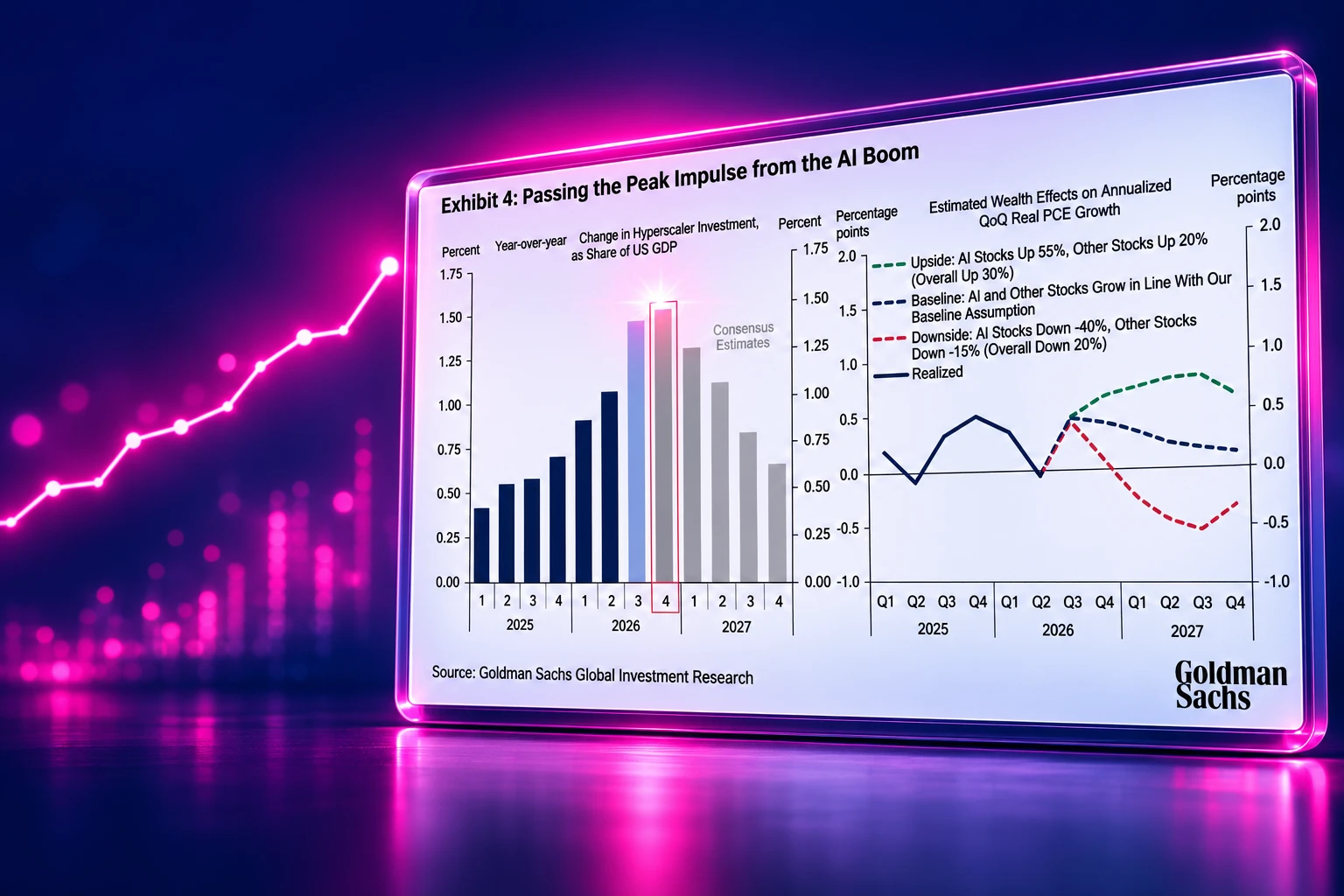
The Handoff Away From Infrastructure
Trivedi’s market call is not that the buildout stops. It is that equity gains are supposed to move off AI infrastructure and into other parts of the market. Tighter financial conditions, he warned, could derail that handoff.
AI has contributed more to market gains than economic growth, so a bigger test for markets than the economy
Kamakshya Trivedi, head of global FX, rates and EM strategy, Goldman Sachs 2027 themes note
That split is already in the 2026 tape. Snider wrote in September that AI investment is driving half of S&P 500 earnings growth this year, with S&P 500 earnings per share up 51% in the second quarter from a year earlier and 26% over the past four quarters, against a 7% average over 30 years. He still sees earnings growth of about 11% in 2027, to $415 a share, as the AI spending tailwind fades and a productivity boost is supposed to take more of the load.
A $250 billion surprise in either direction on next year’s hyperscaler capex would move S&P 500 earnings growth by about 6 percentage points, Snider wrote. That is a different $250 billion from the 2026 bond-sale forecast the credit desk later missed, and it is the swing the equity handoff has to live through. “Stable global growth and declining inflation make for a friendly macro baseline, but risks are to the downside as the market cycle ages,” Trivedi wrote.
Bond Buyers Already Demand a Discount
The handoff runs through credit, because the same companies that juiced stock indexes are now a much larger slice of the bond index. “Record credit and equity issuance has been digestible so far, but with discounted pricing needed in credit, and further widening in US credit spreads is likely,” Trivedi said.
Goldman Sachs’s credit strategy team has already counted $296 billion of hyperscaler bond sales in 2026, above the $250 billion it had forecast for the year, and it expects $440 billion of hyperscaler debt in 2027. Stephen Stowe, director of taxable credit research at Bessemer Trust, put 2025 sales at $93 billion and 2024 at $19 billion.
THE CREDIT LOAD ON THE AI BOOM
| Measure | Figure | Compared with |
|---|---|---|
| 2026 hyperscaler bond sales | $296 billion | $250 billion Goldman forecast |
| 2025 hyperscaler issuance | $93 billion | $19 billion in 2024 |
| Share of U.S. investment-grade market | 5.1% | 2.4% a year earlier |
| Share of index credit risk | 10.3% | 3.7% a year earlier |
Stowe’s November 10 note is the reason those last two rows matter more than the headline supply. The six largest hyperscalers now make up 5.1% of the investment-grade market, up from 2.4% a year earlier, and 10.3% of the index’s combined duration-and-spread risk, up from 3.7%. About 46% of their bonds mature in more than 10 years, so the paper stays in the index. Combined off-balance-sheet lease commitments were about $1.1 trillion as of the second quarter of 2026, more than twice reported long-term debt.
Amanda Lynam, Goldman’s chief credit strategist, has separately tracked $685 billion of hyperscaler purchase commitments due by the end of 2027, a cash use that only partly sits inside consensus capex. Median concessions on the deals have gone from 2.25 basis points in 2025 to 12 basis points in 2026. PIMCO, using Bloomberg data through October 30, put AI-related borrowers at about 44% of 2026 year-to-date non-financial U.S. investment-grade issuance with maturities beyond 15 years, up from about 35% in 2025 and 6% in 2024.
Anyone holding a long U.S. corporate fund now owns a growing slice of the AI buildout whether they picked those names or not. Goldman Sachs Asset Management said in its November Market Pulse that higher rates have already produced “greater dispersion and spread widening across the AI complex,” and that it remains cautious on investment-grade tech.
Why $1.4 Trillion Barely Moves GDP
The reason Trivedi can say the economy is less exposed than the stock market is hiding in Goldman’s own arithmetic. Most of the gear is imported, and a chunk of semiconductor investment never shows up cleanly in the business-investment statistics.
AI’S 2027 PUSH TO CAPEX AND GDP
- The run rate: Annualized AI hardware and intellectual-property spending reaches $1.4 trillion by the end of 2027, nearly 4% of the U.S. economy, after topping $900 billion by the end of 2026.
- With semiconductors: AI-related investment directly boosts 2027 capex growth by 5.3 percentage points and U.S. GDP growth by 0.6 percentage points.
- Without semiconductors: The same spend boosts 2027 capex growth by 4.3 percentage points and GDP growth by only 0.2 percentage points.
- The leak: “Semiconductor investment is undercounted in the business investment statistics, and most information processing equipment is imported and is thus netted out of GDP,” Goldman said on November 12.
Four tenths of a point of GDP is not the same object as nearly half of S&P 500 earnings growth. The wealth effect Hatzius measured, 0.4 percentage points of consumer-spending growth, is the market channel in another form: stock prices feeding spending, then fading as the impulse cools. That is why a peak in the impulse can leave measured GDP only a little softer and still knock a market that has been pricing the buildout, not the import leak.
Emerging Markets Hold the Other End of the Wire
If U.S. equity gains are supposed to leave the server halls, Trivedi is pointing at emerging markets as one place that can take the other side, citing high, diversified yields and regionally diverse earnings. Goldman Sachs Asset Management, in the same November pulse, said EM multiples are now cheaper than 90% of recent history over the last 20 years, after annualized EM earnings growth of just 3% from 2005 to 2025.
The catch inside that cheapness is that a lot of the recent EM earnings burst still comes from the same AI hardware chain. GSAM noted outsized growth among the three main hardware providers and said it also sees room in chip inputs, testing, packaging, and distribution. A U.S. infrastructure handoff that works would broaden that, into commodities and consumers. A U.S. infrastructure handoff that fails would hit those hardware names first.
Andrew Tilton, Goldman’s chief Asia Pacific economist, said on November 12 that India could benefit if global investors rotate toward markets that have been less tied to the AI trade, with GDP growth still above 7% in the near term. That rotation is the same bet Trivedi is making in developed-market stocks, just in a different postcode.
What Can Stop the Rotation Goldman Needs
Trivedi’s baseline is friendly: steady global growth, declining inflation, energy prices easing. The list of things that break the handoff is short, and most of it is already moving.
THE BREAKS ON THE 2027 HANDOFF
- Tighter money: Trivedi said tighter financial conditions could derail the shift of equity gains away from AI infrastructure.
- Wider credit: He already expects further widening in U.S. credit spreads after discounted pricing on record issuance, and Goldman’s credit desk is still looking at $440 billion of hyperscaler debt in 2027.
- Oil spike: Goldman expects energy prices to decline gradually, with Tilton putting Brent around $80 a barrel by late 2027, but a spike from renewed Middle East escalation remains one of the largest near-term risks in Trivedi’s note.
- A capex miss: Snider’s $250 billion surprise, in either direction, still moves S&P 500 earnings growth by about 6 percentage points, which is enough to scramble a rotation that depends on the rest of the market picking up the slack.
GSAM’s base case is that energy prices moderate as supply and demand normalize and the risk premium recedes, with the same Middle East upside sitting on the other side of that call. The aging cycle Trivedi flagged does not need a recession to make the handoff fail. It needs funding costs to stay high enough that buyers keep treating AI paper as a different market, and that the rest of the equity tape never gets the flows the infrastructure names have been absorbing.
The $1.4 trillion run rate can still print. The impulse can still peak. The open question Trivedi left on the table is whether credit lets the rest of the market take the baton before that peak arrives.
Disclaimer: This article is news reporting and analysis of Goldman Sachs research views and related market data, and it is informational only. It is not investment advice, a recommendation to buy or sell any security, or a forecast you should trade on. Readers should consult a qualified financial adviser or licensed investment professional before making any investment decision. Figures and forecasts reflect the cited research as published on the dates named in this article and may change.

Ken Urker’s Accidental Overdose Leaves His Finders Waiting

A Third Carrier Arrives as Hormuz Tankers Keep Burning

Shoe Prices Hit a Record as Flagship Pairs Stay Put

Nvidia’s First Call Without Huang Tests the Money Machine

Blake Griffin Says Oklahoma City Taxpayers Bought a Thunder Arena

Warsh Rejects Rate Guidance and Still Moves Markets

Davina McCall Reveals Cardiovascular Disease After Cholesterol Warnings

Dana-Farber Exits an MGB Medicare Advantage Network Early

NASA Launches the Roman Space Telescope’s Cosmic Bet

OpenAI’s Cyber Letter Puts the Defense Bill on Governments
-
 BUSINESS3 months ago
Warsh Rejects Rate Guidance and Still Moves Markets
-
 ENTERTAINMENT4 weeks ago
Davina McCall Reveals Cardiovascular Disease After Cholesterol Warnings
-
 BUSINESS2 months ago
Dana-Farber Exits an MGB Medicare Advantage Network Early
-
 NEWS3 months ago
NASA Launches the Roman Space Telescope’s Cosmic Bet
-
 NEWS3 months ago
OpenAI’s Cyber Letter Puts the Defense Bill on Governments
-

 NEWS3 months ago
Russia Recycles Its Old Warning Over Storm Shadow Plants
-
 ENTERTAINMENT2 months ago
Primetime’s $2.7 Million Preview Tops Pitt’s Costlier Film
-

 BUSINESS3 months ago
Jet Drones Lock Down Kyiv and Strip Kherson of Heat