
BUSINESS
Milei’s Oil Boom Meets His Bid to Freeze Sea Lion
Milei’s government wants Hamburg to halt Falklands Sea Lion while Argentina’s own oil drive grows, and island royalties already sit in Stanley’s plans.

Argentina asked the International Tribunal for the Law of the Sea on 11 November 2026 to freeze the Sea Lion oil project off the Falkland Islands. The Hamburg hearing is the last of two days. Buenos Aires wants emergency orders that would halt a field already financed, licensed and timed for first oil in March 2028.
The president driving the case is Javier Milei, who is courting oil money at home and telling firms they cannot work Argentina’s shale belt and Sea Lion at once. London is in the same room defending barrels that do not even count toward the UK’s carbon budgets.
Argentina Asks Hamburg to Stop the Wells
The case is listed as No. 37, the Case concerning hydrocarbon exploitation in the South-West Atlantic Ocean (Argentina v. United Kingdom), Provisional Measures. Judge Maurice K. Kamga, president of the tribunal, fixed the dates by an order of 20 October 2026 after hearing both governments. Argentina’s agent is Mario Javier Agustín Oyarzábal, legal adviser at the foreign ministry. The United Kingdom’s agent is Sally Langrish of the Foreign, Commonwealth and Development Office. Attorney General Ellie Reeves KC MP appeared as an advocate, with Sir Michael Wood KC among British counsel.
This is not a trial of who owns the islands. It is a request for interim orders while a slower Annex VII arbitration is still being formed. Under article 290, paragraph 5 of the UN Convention on the Law of the Sea, the tribunal may act if it finds, at first look, that the future arbitral panel would have jurisdiction and that the situation is urgent. The parties must comply promptly with any order it makes.
Argentina opened the fight with a notice to London on 28 September 2026. The United Kingdom refused, in writing, on 11 October. Two days later Buenos Aires asked Hamburg to step in. Argentine officials have framed the filing as the first time the country has sued the United Kingdom in a court outside the two states over the islands’ resources.
THE HAMBURG CALENDAR
- 28 September 2026: Argentina institutes Annex VII arbitration over oil work in the South-West Atlantic.
- 11 October 2026: The United Kingdom refuses to adopt the emergency orders itself.
- 13 October 2026: Argentina asks the Hamburg tribunal to prescribe the orders instead.
- 20 October 2026: The president of the tribunal fixes a two-day public hearing.
- 10 and 11 November 2026: Oral arguments in the main courtroom; an order is reserved.
Oyarzábal told the judges that a dispute is aggravated by unilateral work while title is still contested, not by taking the fight to a court. Hydrocarbons, he said, cannot be restored once they are lifted. Reeves answered that Argentina wants “to take control of those resources for itself,” and that the application is a sovereignty claim in other clothes.
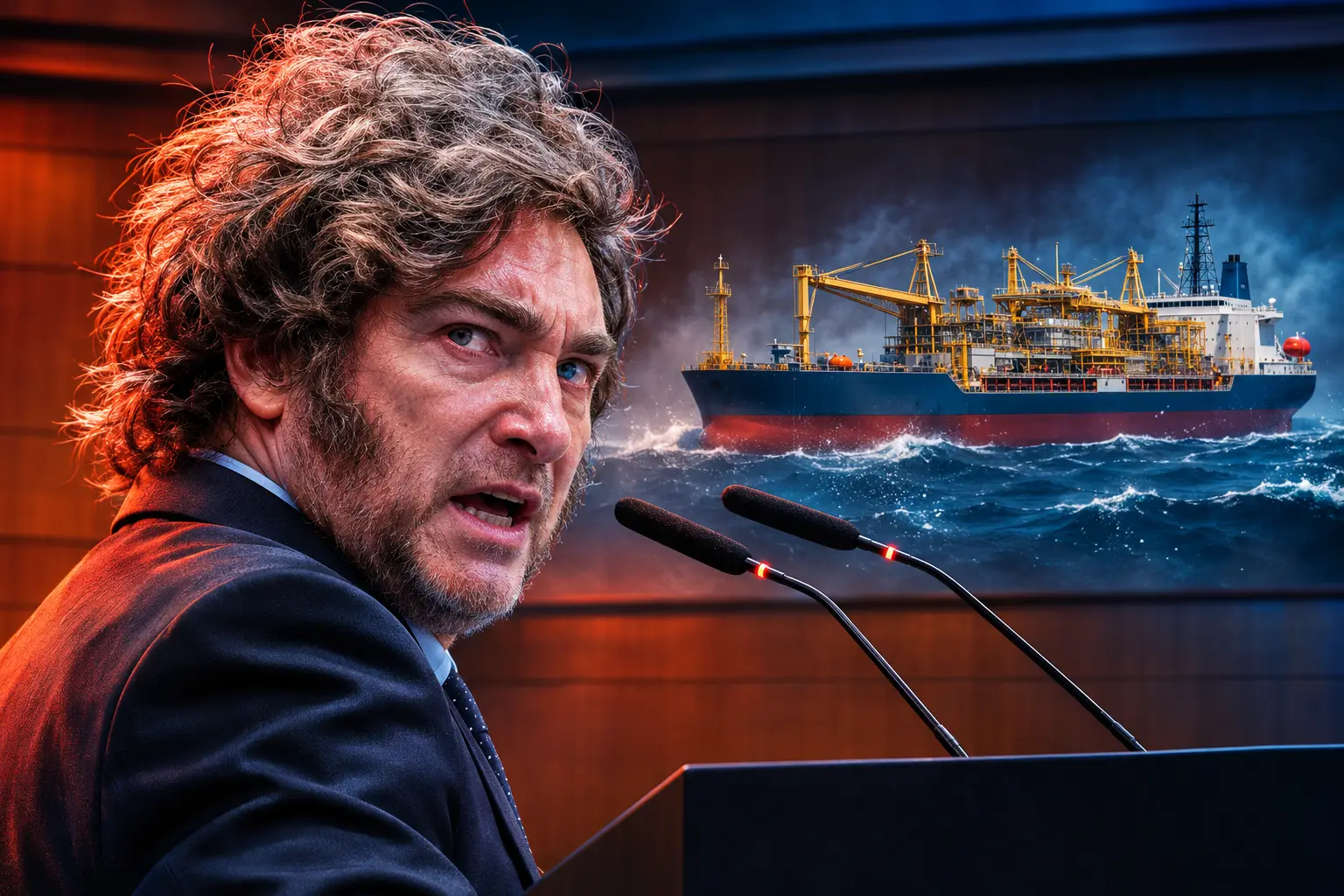
Sea Lion’s $1.8 Billion Path to First Oil
Sea Lion sits in production licences PL032 and PL004b, about 220 km north of the islands in the North Falkland Basin. Rockhopper Exploration, a UK company, found the field in 2010. After missed investment dates and a change of operator, Israel’s Navitas Petroleum took 65 percent through a UK subsidiary, Navitas Petroleum Development and Production Ltd. Rockhopper kept 35 percent. Both companies took a final investment decision on the northern development in December 2025.
Navitas says the work will run from offices in London, Aberdeen and Stanley, and that first oil is planned for March 2028. Phase 1 is 11 subsea wells tied back to a redeployed floating production, storage and offloading vessel. Phase 2 adds 12 wells about three years after first oil. The operator has published an environmental impact statement, an economic impact assessment and a social impact assessment under Falkland Islands rules. Production is expected to last for over 30 years.
SEA LION PHASE 1, AS BOOKED
| Project fact | Figure |
|---|---|
| Distance from the islands | About 220 km north |
| Working interest | Navitas 65 percent, Rockhopper 35 percent |
| Wells in Phase 1 | 11 subsea wells to an FPSO |
| Peak rate, Phase 1 | About 50,000 barrels a day |
| Phase 1 oil target | 170 million barrels |
| Field 2P reserves | 314 million barrels (Netherland, Sewell) |
| Spend to first oil | $1.8 billion ($2.1 billion to completion) |
| First oil date | March 2028 |
An independent audit by Netherland, Sewell & Associates, issued after the investment decision, reclassified a large part of the field as proved and probable reserves. That book, 314 million barrels, is the figure Rockhopper has used in 2026 updates. Drilling and completion work is marked for early 2027. A second FPSO is already in the partners’ plans and could lift later output toward 180,000 barrels a day, according to Rockhopper. Sam Moody, Rockhopper’s chief executive, has said the operator remains on that 2028 timetable.
Stanley Has Already Counted the Royalties
The House of Commons Library puts 3,600 British citizens on the Islands, a self-governing overseas territory except in foreign affairs and defence. Fisheries still dominate the local economy. Sea Lion is the first producing oil project the territory has sanctioned, and Stanley has already written the barrels into public finance.
The Falkland Islands Government’s approved estimates show 2026/27 revenue of £120.6 million against departmental and plan spending of about £120.4 million, a thin surplus before depreciation and a deficit once that charge is applied. An Executive Council paper in March 2026 put royalties from Sea Lion phases 1 and 2 at about $2 billion over 30 years. The territory takes a 9 percent production royalty. Corporate income tax sits between 21 and 26 percent. The Islands Plan for 2026 to 2030 names a sovereign wealth fund, due to start in 2030, as a first-year priority, beside a capital programme of more than £300 million for a new port, housing, waste, wind power and the regulation of a hydrocarbons industry.
WHAT SEA LION IS WORTH TO STANLEY
- Royalty rate: The government takes 9 percent of production, plus corporate tax of 21 to 26 percent.
- Royalty haul: An Executive Council paper estimates about $2 billion in royalties over 30 years from phases 1 and 2.
- Tax and royalty total: The project’s economic impact work puts combined take at about $4.9 billion over the same span, or about $147 million a year.
- Wealth fund: Stanley has cleared work on an oil-royalty fund that would start in 2030, two years after first oil.
That $147 million annual average is close to the islands’ whole administrative take of about $162 million in 2023/24. The same impact work, prepared for the northern development, puts a GDP addition of about $10.9 billion over three decades against a baseline economy of about $379 million a year. Much of the profit and specialist pay would leave the islands. Even so, Reeves told the tribunal the people there risk “losing billions of pounds in money, which is essential for the islands’ economic development,” if the freeze is granted. After Argentina’s September measures, the Falkland Islands Government lengthened existing offshore production licences.
Milei Tells Oil Firms to Choose Vaca Muerta
In a nationwide address in September 2026, Milei said companies operating on the islands behind his government’s back would have to choose “a profitable, secure operation in a sovereign country” or “an illegal gamble in disputed territory.” “You can’t do both,” he said. The prize on his side of the water is Vaca Muerta, the shale formation his government is selling to the world as Argentina’s oil future. YPF, the national producer, is still raising shale output under that drive.
The same month, Argentina opened sanctions proceedings against 60 people and companies tied to oil work around the islands, and prepared a bill to toughen a 2011 sanctions law so that it reaches shareholders, staff and suppliers. Navitas and Rockhopper have both been barred from working in Argentina before. Milei also revived work on a naval base at Ushuaia, in Tierra del Fuego, with completion talked of by 2029, while a presidential spokesperson still called the claim “diplomatic, peaceful, not military.”
The environmental language in Hamburg sits next to that domestic oil push. Argentina’s request asks the tribunal to order the United Kingdom to stop blocking Buenos Aires from meeting duties under articles 192 and 194 of the Convention, which require states to protect the marine environment and to prevent pollution from seabed work. The move turns a sovereignty fight into a claim that Argentina is being stopped from doing its environmental job. At home, the same government is not applying that freeze to its own shale wells.
Foreign Minister Pablo Quirno posted the Hamburg argument overnight between the two hearing days, quoting Oyarzábal and saying the oil cannot be put back.
“Una controversia no se agrava por someterla a un tribunal, se agrava mediante acciones unilaterales mientras aún se encuentra en disputa. Eso es lo que nos trae aquí”. Mario Oyarzábal, Consejero Legal de la @Cancilleria_Ar, hoy en Hamburgo ante el Tribunal Internacional del Mar.… pic.twitter.com/CCPiSxlf9f
— Pablo Quirno (@pabloquirno) November 11, 2026
In Buenos Aires the hearing is being sold as proof that Malvinas policy now has a courtroom, not only a slogan. Jorge Emilio Nunez, a reader in legal philosophy at Manchester Metropolitan University, has said a legal win would let the government claim it is defending national resources, while a setback would be used by opponents, and that Argentine voters still rank the economy above the sovereignty dispute.
What a Freeze Would Do to Drilling
Argentina’s request for four provisional measures against the United Kingdom is specific. The tribunal is not being asked, in this round, to award the islands. It is being asked to pause the field.
WHAT ARGENTINA WANTS HALTED
- The field itself: London must prevent the start or continuation of Sea Lion oil work on the continental shelf in the North Malvinas Basin.
- The seismic file: London must not use exploration data from the disputed waters against Argentine rights.
- The green duty: London must stop preventing Argentina from protecting the marine environment under articles 192 and 194.
- New paper: London must issue no new permits that would deepen the dispute.
Behind those asks sits a statement of claim that the United Kingdom breached articles 2, 56 and 77 on sovereignty and sovereign rights, ignored a duty to refrain from unilateral work during a UN decolonization process, breached Part XII on the marine environment, and failed to settle the dispute peacefully. Buenos Aires leans on UN General Assembly resolution 2065 of 1965, which called for talks, and on a 1976 resolution on unilateral modifications that called on both states to refrain from decisions that would change the situation while talks were meant to continue. Those resolutions are recommendations. The UK government says they do not dilute the Islanders’ right of self-determination under the UN Charter, and that they do not require lawful economic activity to stop.
The provisional measures sought by Argentina would prevent the people of the Falkland Islands from developing their natural resources as they are entitled to do so, pursuant to their fundamental right to self-determination. The measures sought would have devastating consequences for the Falklands people. They risk losing billions of pounds in money, which is essential for the islands’ economic development.
Ellie Reeves, Attorney General, International Tribunal for the Law of the Sea
Sir Michael Wood told the court Argentina is trying to “shoehorn” a territorial sovereignty fight into the Law of the Sea Convention. He warned that if the tribunal issues emergency orders in a case that should be exceptional, it could lose member states. British counsel also asked why the application arrived only in recent months if the harm is as urgent as Buenos Aires claims. Drilling is still months away. First oil is more than a year beyond that. Reeves, asked whether the United Kingdom would obey an order, said she respected the institution and would not get ahead of its decision.
Oyarzábal said Argentina “respects the interests of the inhabitants of the islands and their way of life as enshrined in the Argentine constitution.” “What these British citizens do not have is a right to decide to which state the islands belong,” he said. “These resources belong to the Argentine people. Some 46 million of them, including the 1,247 inhabitants born on the islands, whose interests will be duly taken into account.” The 1,247 figure is births, not the resident population of 3,600. In 2013, 1,513 of 1,517 voters, 99.8 percent, chose to remain a UK overseas territory. Jack Ford, chair of the Legislative Assembly, said in September that claims of this kind “have been made against the Falkland Islands many times over many years” and were “nothing new.”
Prime Minister Andy Burnham’s spokesman said before the hearing that it “is not about the sovereignty of the Falklands,” that the United Kingdom was fully engaged in the UNCLOS process, and that it would “robustly defend our interests and those of the Falkland Islanders.” Burnham raised the economic cost of Argentina’s measures on a 23 October 2026 call with US President Donald Trump. Milei has treated Trump’s refusal to say whether Washington would back Britain in a future fight over the islands as a “winds of change” moment. The Commons Library notes that Falklands emissions do not count toward UK carbon budgets, and that UK oil and gas policy does not apply there. That is why a government that has made North Sea licensing politically hard can still walk into Hamburg and defend Sea Lion without booking the barrels against its own climate targets.
Spill Models From a Nearby Well Failure
Argentina’s urgency case is environmental as well as legal. The file points to spill risk in harsh South Atlantic conditions and to a 2015 blowout preventer failure at the Isobel Deep well in the same basin. Counsel say the first production well is enough to start harm that a later award cannot unwind, because the oil is finite and the seabed work is physical. Argentine environmental lawyers have also won a domestic caution from federal judge Mariel Borruto in Río Grande, ordering the companies to refrain from physical work until an impact assessment is run under Argentine law. That order has no reach on a Falklands licence. It is a parallel track, not a Hamburg substitute.
Navitas has already filed an environmental impact statement with the Falkland Islands Government covering Phases 1 and 2. The dispute is which state’s environmental process counts. Buenos Aires says there is no valid Argentine assessment, so the work is unlawful on a shelf it claims. London and Stanley say the islands’ own ordinance governs a field in waters they administer, and that Argentina has shown no imminent threat of serious harm. Nunez’s point sits under both files: the oil is the trigger, and it intensifies the older fight over title, the Islanders’ vote, and control of the sea around them. It does not replace that fight.
The Tribunal’s Order Is Due This Year
Rockhopper told the market on 10 November 2026 that the Hamburg hearing is a state-to-state matter and that it expects a judgment before the end of the year. The company said it would update investors on any effect on Sea Lion when it can. Navitas has kept the March 2028 first-oil date on its project page through the sanctions talk and through the filing. Early 2027 drilling is the first date an order could actually hit.
If Hamburg grants the freeze, the partners would have to stop physical work and new permits while the Annex VII tribunal is still being built, a process that can run far past a drill season. Reeves said a pause would kill the project, not merely delay it, because financing and contracts are already live. If the tribunal refuses, Argentina still has the main arbitration, the sanctions bill, and a domestic court order that the companies will ignore in Stanley. Milei also has an election calendar next year in which a visible legal win would be useful and a loss would be explained away.
The judges ad hoc, Vaughan Lowe for one side and Raúl Vinuesa for the other, made their solemn declarations on 9 November 2026. The courtroom then sat for two days. The order, when it comes, will decide whether a field the islands have already banked into a 2030 wealth fund can keep its 2027 wells, or whether Milei’s environmental case, written for a project his own oil policy would otherwise cheer, stops the drill before the first barrel moves.

Ken Urker’s Accidental Overdose Leaves His Finders Waiting

A Third Carrier Arrives as Hormuz Tankers Keep Burning

Shoe Prices Hit a Record as Flagship Pairs Stay Put

Nvidia’s First Call Without Huang Tests the Money Machine

Blake Griffin Says Oklahoma City Taxpayers Bought a Thunder Arena

Warsh Rejects Rate Guidance and Still Moves Markets

Davina McCall Reveals Cardiovascular Disease After Cholesterol Warnings

Dana-Farber Exits an MGB Medicare Advantage Network Early

NASA Launches the Roman Space Telescope’s Cosmic Bet

OpenAI’s Cyber Letter Puts the Defense Bill on Governments
-
 BUSINESS3 months ago
Warsh Rejects Rate Guidance and Still Moves Markets
-
 ENTERTAINMENT1 month ago
Davina McCall Reveals Cardiovascular Disease After Cholesterol Warnings
-
 BUSINESS2 months ago
Dana-Farber Exits an MGB Medicare Advantage Network Early
-
 NEWS3 months ago
NASA Launches the Roman Space Telescope’s Cosmic Bet
-
 NEWS3 months ago
OpenAI’s Cyber Letter Puts the Defense Bill on Governments
-

 NEWS3 months ago
Russia Recycles Its Old Warning Over Storm Shadow Plants
-

 ENTERTAINMENT2 months ago
Primetime’s $2.7 Million Preview Tops Pitt’s Costlier Film
-

 BUSINESS3 months ago
Jet Drones Lock Down Kyiv and Strip Kherson of Heat