
BUSINESS
Apple’s $5 Trillion Crown Lasted Only Hours on Duo Day
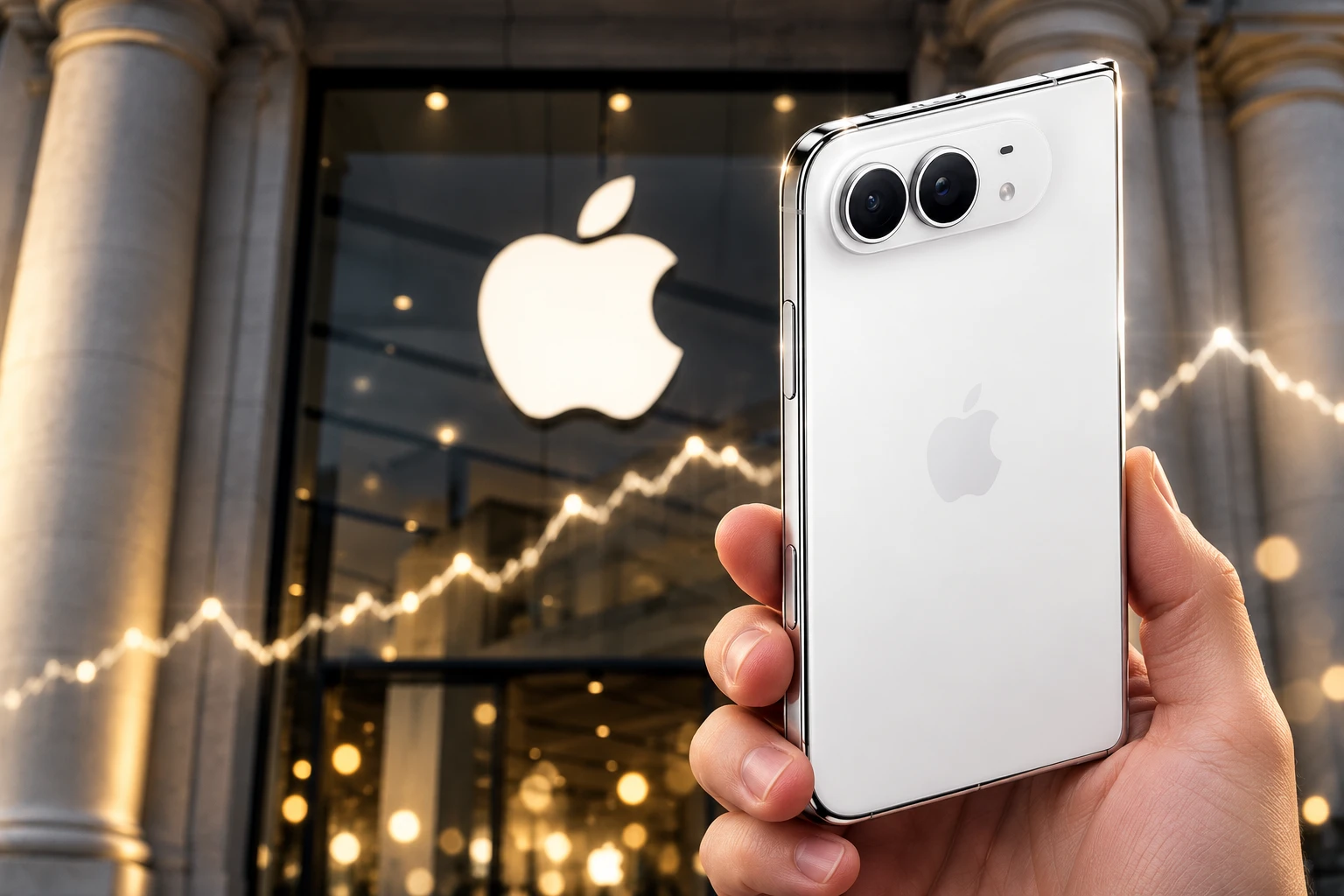
Apple passed Nvidia on iPhone Duo launch morning, then closed smaller at $5.071 trillion as the $1,999 foldable’s thin first batch was already gone.

Apple passed Nvidia for a stretch of Friday, October 23, then finished the session still smaller, as the iPhone Duo reached stores. FinanceCharts lists the close at $5.071 trillion against Nvidia’s $5.096 trillion.
The $1,999 foldable’s first stock had already vanished in October 16 preorders. The ranking that moved with it was a gap of tens of billions on a $5 trillion base, and Nvidia had it back by the bell.
Did Apple Finish Friday as the Most Valuable Company?
No. Apple printed an intraday high of $351.73 and an early trade of $349.55, up 0.4 percent, which put it near $5.10 trillion while Nvidia sat near $5.06 trillion. Apple closed Friday at $347.73, down 0.14 percent, with 14.609 billion shares outstanding.
Nvidia closed at $210.96, down 0.59 percent, on 24.147 billion shares. That $25 billion gap is 0.5 percent of Apple’s close. A one percent swing in either name flips the title.
APPLE AND NVIDIA ON OCTOBER 23
| Apple | Nvidia | |
|---|---|---|
| Thursday close, October 22 | $348.22 ($5.081T) | $212.21 ($5.124T) |
| Friday close, October 23 | $347.73 ($5.071T) | $210.96 ($5.096T) |
| Friday change | -0.14% | -0.59% |
| Shares outstanding | 14.609 billion | 24.147 billion |
Nvidia still led on Thursday by $43 billion. Both stocks fell on Friday. Nvidia’s drop was small enough to keep first place. By Monday, October 26, FinanceCharts had Apple at $343.91, or $5.026 trillion, with Nvidia at $5.217 trillion.
Preorders Cleared the First Batch on October 16
Stores opened on October 23. The rush that Wall Street treated as launch-day demand had already hit Apple’s site a week earlier. Preorders opened on October 16 at 8:00 a.m. Eastern. Within about 30 minutes, U.S. configurations showed a delivery date of January 25, 2027.
The pre-order demand for iPhone Duo, our first foldable iPhone, has been nothing short of extraordinary.
Apple, statement, October 16, 2026
Apple kept taking orders and said it was working to get units out. It did not publish a unit count. Neil Shah of Counterpoint Research put 2026 shipments at 5 million to 6 million at the high end, after hinge and panel qualification slipped from a May-July mass-production plan into a September ramp.
THE DUO’S PATH FROM UNVEIL TO LAUNCH
- September 9, 2026: Apple unveils iPhone Duo and sets preorders for October 16, with store availability on October 23.
- September 17, 2026: A Foxconn-chain source puts final assembly yield slightly above 60 percent, with hinge and foldable OLED supply still tight.
- October 16, 2026: Preorders sell through in minutes in the U.S., Korea, Germany and other markets; new orders slip toward late January 2027.
- October 21, 2026: Apple tells stores they will have only a limited number of walk-in units on Friday.
- October 23, 2026: The phone goes on sale in more than 70 countries; 28 more markets follow on October 30.
Early line output in September was described as a few hundred units a day, with the hinge the bottleneck. Apple capped online orders at two per customer in the U.S., mainland China, Hong Kong and Singapore. Japan and Korea required a store pickup appointment. Some Korean resellers were already asking a premium of 500,000 won, about $350, over list.
A Samsung Panel in Every $1,999 Duo
The phone Apple put on the site starts at $1,999 for 256GB, with 512GB, 1TB and 2TB behind it, and 24-month payments from $83.29, or a lease from $57.99. Colors are star white and night sky. The frame and hinge cover are grade 5 titanium.
Both screens come from Samsung Display, which OLED-Info says is the exclusive supplier, using crease-less foldable OLED and its M16 material set. Samsung’s phone group still sells Galaxy Z Fold against this product. Its display group gets paid on every Duo that leaves Foxconn.
DUO HARDWARE THAT HIT STORES ON OCTOBER 23
- Inner display: A 7.6-inch Super Retina XDR panel that Apple says is 50 percent larger than iPhone 18 Pro Max, at 3,000 nits peak.
- Outer display: A 5.4-inch cover that Apple says has more than 90 percent of the screen area of iPhone 18 Pro, with the same aspect ratio as the inner panel.
- Chip and battery: A vapor-cooled A20 Pro and a dual-battery pack Apple rates at up to 31 hours of video on the inner display and 44 hours on the outer one.
- Build: Titanium hinge cover, under-display FaceTime camera, 48MP Dual Fusion rear cameras, and iOS 27.1 at launch.
CEO John Ternus, who took the job this cycle, used the September event to put the foldable on the same shelf as the original iPhone.
iPhone Duo is the most transformational change to iPhone since the original. With an entirely new design and intuitive experiences, it shows what’s possible when hardware and software are engineered together and redefines what it means to use a foldable phone.
John Ternus, CEO, most transformational change to iPhone newsroom briefing, September 9, 2026
Hold that line against the shipment math. A first foldable can move a morning print. It is still a thin slice of iPhone.
Why Analysts Cap 2026 Shipments at 6 Million
Jeff Pu, who had already cut a 7 million 2026 Duo figure to 6 million on hinge yield, still looks for about 72 million iPhone 18 Pro and Pro Max units this year. That is roughly 12 Duo-sized books of Pro phones for each book of foldables.
Taiwan supply-chain accounts on October 22 described a different clock: a 12-month build plan of 14 million units, up 44 percent from 9.7 million. That window runs past December 31. Shah’s 5 million to 6 million is a 2026 shipping cap, and he said unmet demand should spill into early 2027 rather than into a rival foldable.
U.S. stores were described as holding about 50 to more than 200 units each for walk-ins. One Los Angeles shop was out by about 6:30 a.m. for customers who had not preordered. Evercore ISI tracked lead times near 100 days across regions. The January queue is what a 60 percent assembly yield looks like at retail, not a 200 million-unit iPhone franchise taking a new shape overnight.
The Crown Has Changed Hands Two Dozen Times
Friday was the fifth time Apple has taken the top slot back from Nvidia, and the pattern is that the pass rarely holds through a close, let alone a quarter. Nvidia first closed as No. 1 on June 18, 2024, and has sat there almost without a break since June 2025, aside from a four-session Apple run in late July.
Apple last finished a full session as the most valuable listed company on July 30. The one stretch that lasted came in January 2025, when the DeepSeek scare hit chip stocks and Apple kept the rank into spring. A count of closing ranks since the start of 2024 puts the handoffs at two dozen.
For most of the decade before that, Apple closed as the most valuable U.S.-listed company in about 7 of every 10 sessions after October 2015. Microsoft took long turns. Amazon held the top for 12 sessions in early 2019. Alphabet had a single day in 2016. The AI boom turned the top two names into a photo finish. On October 23 the finish still belonged to Nvidia.
People posting as the open printed treated the morning pass as a regime change, a phone that folds outrunning a chip boom. The hinge is what owners argued about by the weekend. Delivery dates already ran into January. Nvidia did not need Monday to take the crown back. It had it at 4 p.m. Eastern on Friday.
Some Launch Units Cracked Along the Hinge
On October 26 Apple said it was aware of an issue impacting the inner display on a small number of iPhone Duo units, and that replacements were going through AppleCare and stores. Stock is still tight, so some owners wait. Apple also said most units would not show the fault and that it was not a wear-out crack that appears over time.
Owners described a tight hinge, a pop, then a bright line of dead pixels along the fold. One Australian buyer said the inner screen split after fewer than 20 opens, about six hours after unboxing, with no mark on the outer glass. Demo units in some China stores showed the same line. iFixit tore a unit down on October 25, scored repairability 5 out of 10, and mapped the failures.
Its breaks cluster near the hinge at the gap where a crossing flex cable meets the central support. A fluorescent-powder test found dust reaching moving parts until the hinge crunched. Apple’s own service menu prices an inner display at $999, or $99 with AppleCare. Tom Marieb, vice president of hardware engineering, had told reporters before launch to hold Apple accountable for the crease.
WHAT WE KNOW
- Apple’s scope: The company calls it a small number of inner-display units and is swapping them.
- Where it fails: Reports cluster on a line along the hinge after a stiff fold and a pop, including some phones opened fewer than 20 times.
- Repair cost: Inner display service is $999 without AppleCare and $99 with it, on Apple’s published menu.
WHAT IS UNCONFIRMED
- The rate: Apple has not given a percentage of the launch batch, and public posts are not a sample.
- The cause: iFixit’s hinge model is a theory about a support bar and flex-cable gap, not a finding Apple has adopted.
- The ranking: Nothing in the crack reports moves Friday’s close; Nvidia finished larger, and Monday’s prints left it larger still.
The $5 trillion club now has two members who trade places inside a 1 percent band. iPhone Duo is a $1,999 product with a January queue, a Samsung panel, and a hinge that already sent some launch-day buyers back to the store. That is the hardware Apple asked the market to reprice on October 23, and the close still went to Nvidia.
Disclaimer: This article is news reporting and analysis for general information. It is not a recommendation to buy or sell Apple, Nvidia, Samsung, or any other security, and it is not investment, tax, or trading advice. Readers should consult a licensed financial adviser who can weigh their own holdings, time horizon, and risk limits before acting on market-cap rankings or product-launch headlines. Share prices, unit forecasts, delivery dates, and repair policies change, and the figures here reflect the datasets and company statements cited, which may already have moved.

Ken Urker’s Accidental Overdose Leaves His Finders Waiting

A Third Carrier Arrives as Hormuz Tankers Keep Burning

Shoe Prices Hit a Record as Flagship Pairs Stay Put

Nvidia’s First Call Without Huang Tests the Money Machine

Blake Griffin Says Oklahoma City Taxpayers Bought a Thunder Arena

Warsh Rejects Rate Guidance and Still Moves Markets

Davina McCall Reveals Cardiovascular Disease After Cholesterol Warnings

Dana-Farber Exits an MGB Medicare Advantage Network Early

NASA Launches the Roman Space Telescope’s Cosmic Bet

OpenAI’s Cyber Letter Puts the Defense Bill on Governments
-
 BUSINESS3 months ago
Warsh Rejects Rate Guidance and Still Moves Markets
-
 ENTERTAINMENT1 month ago
Davina McCall Reveals Cardiovascular Disease After Cholesterol Warnings
-
 BUSINESS2 months ago
Dana-Farber Exits an MGB Medicare Advantage Network Early
-
 NEWS3 months ago
NASA Launches the Roman Space Telescope’s Cosmic Bet
-
 NEWS3 months ago
OpenAI’s Cyber Letter Puts the Defense Bill on Governments
-

 NEWS3 months ago
Russia Recycles Its Old Warning Over Storm Shadow Plants
-

 ENTERTAINMENT2 months ago
Primetime’s $2.7 Million Preview Tops Pitt’s Costlier Film
-

 BUSINESS3 months ago
Jet Drones Lock Down Kyiv and Strip Kherson of Heat