
BUSINESS
Eurozone Inflation at 3.8% Traps Lagarde’s Yields Argument
Eurozone inflation hit 3.8% in September, topping the ECB’s 2026 average four days after Lagarde leaned on bond yields.

Eurostat’s Friday flash estimate put euro area annual inflation at 3.8% in September, the highest since September 2023 and above the 3.6% reading markets had penciled in. The rate is up from 3.2% in August, a 0.6 point jump, and it already sits above the 3.0% average the European Central Bank staff forecast for all of 2026.
Energy inflation hit 18.8%. Core inflation, which strips out energy, food, alcohol and tobacco, came in at 2.5%, matching forecasts. Four days earlier, President Christine Lagarde had told EU lawmakers that rising bond yields would slow growth and blunt the energy shock for her.
September’s 3.8% Already Tops the 2026 Average
That 3.8% figure is a monthly annual rate, not a full-year outcome, but it is already 1.8 points above the ECB’s 2% target and 0.8 points above the 3.0% average in the September staff projections. Those same projections see headline inflation at 2.5% in 2027 and 2.1% in 2028. Core is seen averaging 2.5% this year, 2.6% next year and 2.3% in 2028.
THE SEPTEMBER FLASH
- Headline: 3.8% in September, up from 3.2% in August, with a 0.6% monthly rise.
- Energy: 18.8%, up from 14.3%, the highest since January 2023, and 3.9% higher on the month.
- Core: 2.5%, up from 2.4%, in line with what economists had expected.
- Policy rate: The deposit facility is 2.50% after the increase that took effect on Sept. 16.
On Friday morning, before the print, Bank of Finland Governor Olli Rehn told a European Systemic Risk Board conference that dearer energy was pushing the bloc toward the ECB’s adverse inflation case. He also said the rise in long-term rates would slow growth and limit how far the shock feeds into other prices and wages. German 10-year yields were around 3.57%, a 17-year high in that briefing.
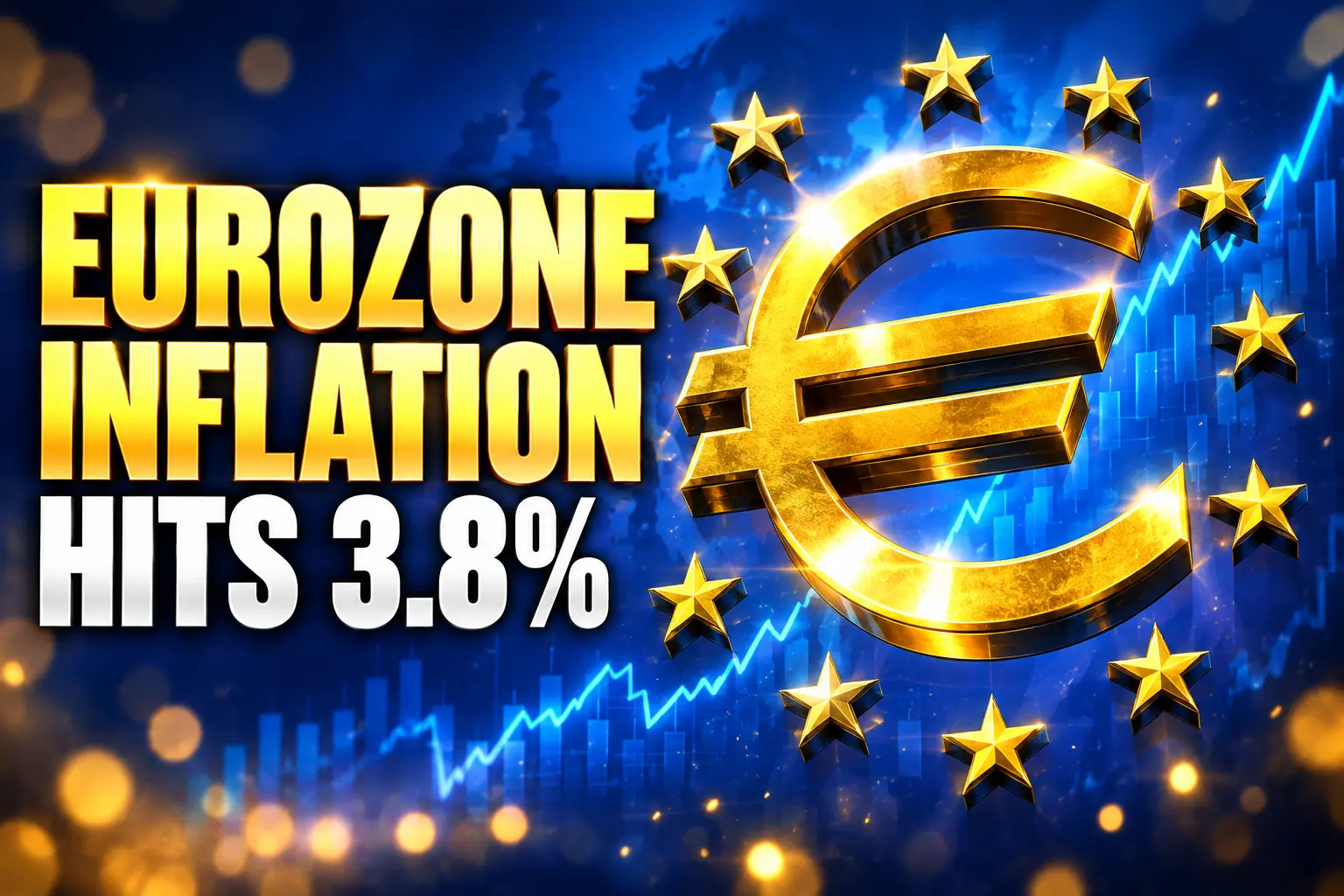
Energy Inflation Hit 18.8%, Highest Since January 2023
Energy is only about 9.0% of the 2026 HICP basket (90.3 parts per thousand), but at 18.8% it added about 1.7 points to the 3.8% headline. Services, almost 46.8% of the basket, rose to 3.2% from 3.0%. Food, alcohol and tobacco rose to 1.4% from 1.1%. Unprocessed food jumped to 4.0% from 2.7%, a 1.3% monthly increase. Non-energy industrial goods eased to 1.1% from 1.2%, the only major group to slow on the year.
HOW THE 3.8% WAS BUILT
| Component | 2026 weight (‰) | Aug % | Sep % | Sep monthly % |
|---|---|---|---|---|
| All-items HICP | 1000.0 | 3.2 | 3.8 | 0.6 |
| Energy | 90.3 | 14.3 | 18.8 | 3.9 |
| Services | 468.2 | 3.0 | 3.2 | -0.7 |
| Food, alcohol and tobacco | 189.4 | 1.1 | 1.4 | 0.2 |
| Unprocessed food | 51.4 | 2.7 | 4.0 | 1.3 |
| Non-energy industrial goods | 252.2 | 1.2 | 1.1 | 2.1 |
| Ex energy, food, alcohol and tobacco | 720.4 | 2.4 | 2.5 | 0.2 |
Inflation excluding energy rose to 2.3% from 2.1%. Harry Woolman, global capital markets analyst at Validus Risk Management, said energy remains the main driver but that September’s jump looks like “more than an energy story,” which is why the Oct. 29 meeting now matters more than it did a week ago. Mohamed El-Erian, the Allianz adviser, wrote that the print added pressure on the ECB “as economies deal with higher borrowing costs.”
Lagarde Had Just Handed the Job to Bond Yields
On Sept. 10 the Governing Council raised the three key rates by 25 basis points, taking the deposit rate to 2.50%, the main refinancing rate to 2.65% and the marginal lending facility to 2.90% from Sept. 16. That was the second increase of 2026, after the deposit rate moved to 2.25% from June 17. The statement said the Middle East conflict was still generating inflation pressure and that inflation would stay well above target “for an extended period.”
On Sept. 28, Lagarde took that message to the European Parliament’s economic committee and leaned on the bond market. Growth had been resilient, she said, but long-term rates had “risen notably” since the last meeting, which “will slow growth and reduce pass-through by more than projected in our September exercise.” She said the bank does not react to energy prices as such, only to the risk that they become stuck in the wider index, and that a “measured response” still fitted a “middle path.”
Looking at these three criteria today, we see higher inflation ahead but no signs yet that it is becoming embedded. The inflation outlook will be higher in 2027 and 2028 than we expected a few months ago, mostly due to higher energy prices. But we do not see evidence at this stage of energy prices feeding into higher wages. And while growth has been resilient, since our last meeting long-term interest rates have risen notably, which will slow growth and reduce pass-through by more than projected in our September exercise.
Christine Lagarde, President of the ECB, European Parliament ECON hearing, Sept. 28, 2026
After those remarks, traders cut the chance of another move on Oct. 29 to about 40%, leaving more of the priced tightening in December, when fresh staff forecasts are due. Woolman said that argument is now harder to sustain.
LAGARDE’S THREE TESTS AGAINST THIS PRINT
- The inflation outlook: Headline at 3.8% is already above the 3.0% 2026 average in the September round, and Rehn said energy is closer to the adverse case.
- Underlying inflation: Core at 2.5% only ticked up a tenth, and compensation per employee slowed to 3.3% in the second quarter from 3.6% in the first.
- Transmission: Long-term yields have risen, which is the brake she cited, but those same yields are the fiscal squeeze governments are already paying.
The no signs yet that it is becoming embedded line is still the doves’ best exhibit. It is also the sentence the 3.8% print now sits beside in every briefing note for Oct. 29.
Which Countries Are Running Hottest?
The euro area has 21 members from Jan. 1, 2026, after Bulgaria joined. Six of them printed at 5.0% or higher. Ten were at or above the 3.8% average. Malta was the low at 2.4%. Lithuania led at 6.1%. Among the large economies, Spain’s 5.0% was the hottest, and that number is being read in Madrid as a domestic cost-of-living fight, not only as an input for Frankfurt.
SELECTED HICP ANNUAL RATES
| Country | Sept % | Aug % | Sept monthly % |
|---|---|---|---|
| Lithuania | 6.1 | 5.6 | 0.9 |
| Bulgaria | 5.6 | 5.0 | -0.1 |
| Spain | 5.0 | 4.6 | 0.6 |
| Italy | 4.1 | 3.2 | 2.0 |
| France | 3.4 | 2.6 | -0.4 |
| Germany | 3.3 | 2.9 | 0.6 |
| Ireland | 3.8 | 3.4 | 0.2 |
| Malta | 2.4 | 2.0 | -0.9 |
Italy’s 2.0% monthly jump and Greece’s 1.8% monthly rise (Greece’s annual rate was 5.1%, up from 3.7%) show how fast fuel can still move a national index. France’s annual rate leapt to 3.4% from 2.6% even as prices fell 0.4% on the month, a reminder that the year-on-year comparison is doing as much work as the latest bill at the pump. Germany, the biggest economy, rose to 3.3% from 2.9%.
Wages Slowed, and That Is the Pause Case
The case for sitting out October is still on the page. Core inflation matched the 2.5% forecast. Services inflation rose only two tenths and actually fell 0.7% on the month. Lagarde told lawmakers the labour market was still robust, with unemployment at 6.4% in July, but that employment and labour-force growth were slowing. Compensation per employee, her preferred wage gauge, cooled to 3.3% in the second quarter from 3.6% in the first. Longer-term inflation expectations, she said, remain around 2%.
That is why some desks still prefer December. Fresh projections land then. A measured path was her phrase on Sept. 28, and a single 3.8% flash, heavy with energy and unprocessed food, does not by itself prove wages have turned. The 2022 sequence she is trying not to repeat started with energy and then ran through pay deals and services. The pay deals have not turned yet.
A central bank mindful of the experience of 2022 will not want to wait for second-round effects to become entrenched before acting.
Harry Woolman, global capital markets analyst, Validus Risk Management
The Governing Council is not pre-committed to a path. The Sept. 10 statement said interest-rate decisions would rest on the inflation outlook, underlying inflation, and how strongly policy is getting through. All three are now in dispute at the same time: the outlook is hotter than the 3.0% 2026 average, underlying inflation is only a tenth firmer, and the “yields will do it” channel is the one this print calls into question.
Oil Near $102 Keeps the Shock Alive
Brent crude settled at $102.31 a barrel on Oct. 1, up $4.28, after a week of mixed supply headlines around the US-Iran war. Refining margins on liquid fuels were already in Lagarde’s August account of why energy inflation had jumped to 14.3%. The HICP the ECB uses for its 2% target still has that fuel in it. Diesel and petrol have been running far ahead of crude in Europe, which is why a 9.0% energy weight can still add 1.7 points to headline inflation.
The same oil move has been pulling sovereign yields with it, the oil and Treasury yields moving in lockstep that Lagarde then recast as useful tightening. If those yields slip, the substitute brake she described on Sept. 28 eases just as the 3.8% print arrives. Postponed Hormuz talks and the oil shock are the physical side of that loop: as long as the strait stays disrupted, the energy rate can stay in double digits into the winter, which is the season the September projections treated as the hump.
Washington has also pressed European governments to tap emergency diesel stocks, a reminder that fuel policy is now a transatlantic argument, not only a Frankfurt one. Rehn’s warning that projections sit under “very high, pervasive uncertainty” is the official version of the same bind.
The Oct. 29 Meeting Is No Longer a Skip
The calendar is tight. Eurostat will publish the full September HICP on Oct. 16. The next flash, for October, is due Nov. 4, after the meeting. The Governing Council convenes on Oct. 29 with a 3.8% headline, an 18.8% energy rate, a 2.5% core, and a president who, four days before the print, said yields would do part of the job.
THE PATH INTO THE MEETING
- June 17, 2026: The first increase of the year takes effect, with the deposit rate at 2.25%.
- Sept. 10, 2026: The Governing Council lifts the three key rates by 25 basis points and says inflation will stay well above target for an extended period.
- Sept. 16, 2026: The deposit rate takes effect at 2.50%.
- Sept. 28, 2026: Lagarde tells Parliament that higher long-term rates will slow growth and cut energy pass-through.
- Oct. 2, 2026: Eurostat estimates September inflation at 3.8%, with energy at 18.8%.
- Oct. 16, 2026: The complete September HICP is due.
- Oct. 29, 2026: The next monetary-policy meeting.
A hold on Oct. 29 would mean living with a headline that has already cleared the 2026 average in the staff round and with energy near the adverse case Rehn flagged. A hike would mean treating a still-soft core and slowing wages as too thin a shield, and putting another 25 basis points on households and firms that are already paying more for fuel and for government debt. Either way, the bond market is no longer an uncontroversial deputy.

Tony Romo Leaves CBS After Naming Pain and Alcohol

Pitt Stays Perfect After Mason Heintschel Leaves on Crutches

Irish Sea Moss Sells an Irish Name for Tropical Gel

Chris Brown’s Housekeeper Takes $9.5 Million Over a Retrial

Moonshot Cannot Recall the Kimi Weights It Is Probing

Warsh Rejects Rate Guidance and Still Moves Markets

NASA Launches the Roman Space Telescope’s Cosmic Bet

Russia Recycles Its Old Warning Over Storm Shadow Plants

Dana-Farber Exits an MGB Medicare Advantage Network Early

Primetime’s $2.7 Million Preview Tops Pitt’s Costlier Film
-
 BUSINESS1 month ago
Warsh Rejects Rate Guidance and Still Moves Markets
-
 NEWS1 month ago
NASA Launches the Roman Space Telescope’s Cosmic Bet
-
 NEWS1 month ago
Russia Recycles Its Old Warning Over Storm Shadow Plants
-
 BUSINESS3 weeks ago
Dana-Farber Exits an MGB Medicare Advantage Network Early
-
 ENTERTAINMENT1 week ago
Primetime’s $2.7 Million Preview Tops Pitt’s Costlier Film
-

 BUSINESS1 month ago
Jet Drones Lock Down Kyiv and Strip Kherson of Heat
-

 NEWS1 month ago
OpenAI’s Cyber Letter Puts the Defense Bill on Governments
-

 NEWS1 month ago
Congo Starts Ervebo Vaccinations for a Different Ebola Virus