
LIFESTYLE
Irish Sea Moss Sells an Irish Name for Tropical Gel
Most Irish sea moss gels are tropical seaweeds sold under an Irish name, with thin human trials and iodine that varies by batch.

Most Irish sea moss sold as a wellness gel is a tropical red seaweed, not the North Atlantic plant that gave the product its name. Global sales are still climbing, and the pitch is a mineral complete set in a spoon. The plant on the receipt is often a carrageenan or agar crop from warm water, and the human trials have not caught the ads.
Tracked US sales logged by SPINS rose from $19.5 million in 2024 to $53.3 million in 2025. The Business Research Company puts the global sea moss market at $3.11 billion in 2025 and $3.99 billion in 2030, a 5% annual clip. That is a lot of money for a food whose Latin name rarely appears on the lid.
Most Jars Are Not the Irish Plant
Sea moss is a trade name, not a species. Three red seaweeds fill the jars, capsules, and gummies. Only one of them is Irish moss.
Chondrus crispus is the North Atlantic plant, also called carrageen moss. It grows on cold rock from Ireland and Scotland to Atlantic Canada and New England. Ireland’s 2020 hand harvest of carrageen, Chondrus counted with its shore neighbor Mastocarpus stellatus, was 37.5 wet tonnes. That is a cottage food, not a global gel pipeline.
The gold and purple “Jamaican” or “St Lucian” moss in US shops is usually Gracilaria, a warm-water genus farmed for agar, or Kappaphycus alvarezii, the cottonii crop of the Philippines, Indonesia, and Tanzania. Steve Eddy of Maine Coast Sea Vegetables, a Maine harvester, has described tropical species mislabeled as Chondrus once the fronds are dried and milled. Powder and capsules make the swap almost impossible to see.
NorrChemica, a Helsinki seaweed lab, wrote on September 18, 2026 that it found no published study that IDs retail sea moss species by species. The US Food and Drug Administration did run DNA on 46 seaweed products sold in the United States and grouped them into 13 species. The red seaweeds in that set included elkhorn sea moss (Kappaphycus alvarezii), a Eucheuma species, and a Gracilaria species. A gel that only says “Irish sea moss” does not tell you which of those you bought.
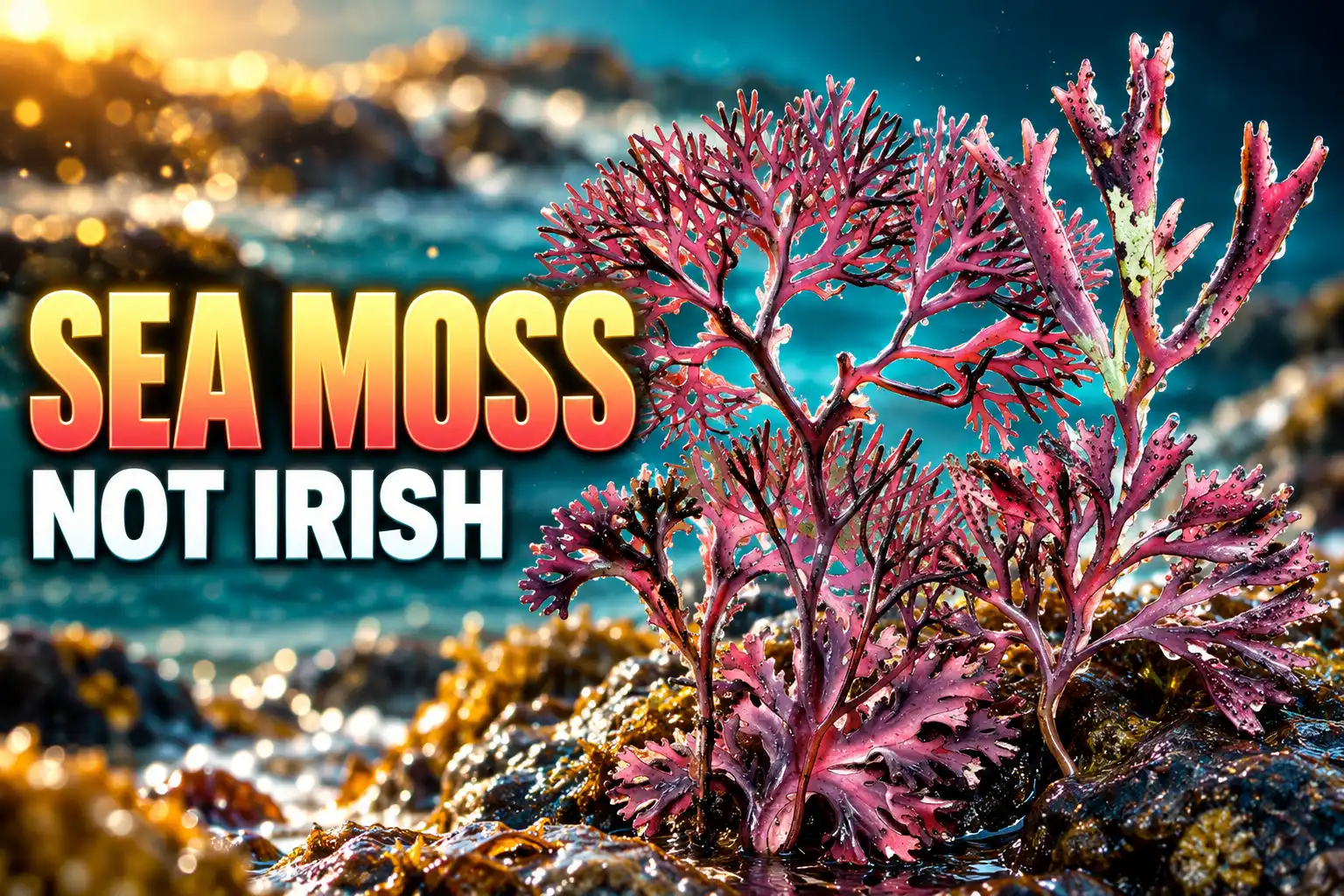
What Irish Sea Moss Is
True Irish moss is a small, frilly red alga. Fresh fronds run from green-yellow through red to dark purple. Dried, they look like dark, flattened fans. Tropical moss tends to have slender, finger-like branches and often dries pale or straw-colored in hard sun. Color is a clue, not a test. Once the plant is blended into gel, only a lab can settle the name.
Johna Burdeos, a registered dietitian, describes Irish sea moss as a seaweed that can supply iodine, iron, magnesium, phosphorus, zinc, and copper. Those minerals are real. They are also ordinary. You already get them from fish, dairy, iodized salt, beans, and greens. A scoop in a smoothie is a food add-in, not a missing food group.
THE THREE SEAWEEDS SOLD AS SEA MOSS
| Plant | Names on labels | Where it grows | Gelling gum |
|---|---|---|---|
| Chondrus crispus | Irish moss, carrageen moss | Cold North Atlantic coasts | Mixed kappa and lambda carrageenan |
| Kappaphycus alvarezii | Cottonii, elkhorn, purple or gold moss | Philippines, Indonesia, Tanzania farms | Mostly kappa carrageenan |
| Gracilaria species | Jamaican or St Lucian sea moss | Caribbean and Indo-Pacific farms | Agar, not carrageenan |
NorrChemica’s composition table is blunt about the rest. Ash, the mineral fraction, in Kappaphycus has been published from 5% to 45% of dry weight. The minerals in a jar are a property of the batch, not a promise of the species.
Carrageenan Farms Now Supply the Gel
The wellness aisle and the ice cream plant are arguing over the same chemistry. Irish moss was the original commercial source of carrageenan, the gelling gum that makes a sea moss gel set. One Portuguese study put the extraction yield at 51% from wild plants. In the 1970s, wild North Atlantic beds could not feed processed food, so producers shifted to farmed Eucheuma for carrageenan in the Philippines. Indonesia later took the volume lead. Industry-adjusted FAO production figures put about 92% of farmed carrageenan seaweed in Indonesia and the Philippines.
Carrageenan’s name comes from the Irish carraigín, “little rock,” tied to Carrigan Head in Donegal. In the 19th century the dried plant went into flans, chest tonics, and beer. During the potato famine of the 1840s, households stirred it into a fortified milk drink during the famine with sugar and spices. Irish migrants carried that kitchen habit to New England and, later, used Caribbean Gracilaria as a stand-in they still called Irish moss.
World War II then turned the gum into factory infrastructure when Japanese agar was cut off. Chocolate milk, toothpaste, and sliced processed meat all learned to lean on it. Food and drinks still take most of the industrial tonnage. The Instagram jar is a retail remix of that supply, sold back to people who already scan other labels for “carrageenan-free.”
HOW THE GUM LEFT THE SHORE
- The 1810s: Irish and British writers describe boiling the moss into a gel and using it as a chest tonic.
- The 1840s: Dried red seaweed goes into warm milk as a famine food, then travels with Irish migrants.
- The 1940s: US processors scale carrageenan as an agar stand-in and as the stabilizer in bottled chocolate milk.
- The 1970s: Farmed Kappaphycus and Eucheuma replace wild Chondrus as the world’s main carrageenan crop.
- The 2010s: Alfredo Bowman, the herbalist known as Dr. Sebi, and later celebrity smoothies turn the gel into a wellness staple.
- 2025: SPINS records $53.3 million in tracked US sea moss sales, up from $19.5 million in 2024.
The farms are not a footnote. In Zanzibar alone, about 24,000 people work the lines, and seaveg cites a figure that 80% of them are women. Almost all of the world’s seaweed, about 97%, is farmed in the ocean on ropes and nets, not gathered wild on Irish ledges. Pool-grown moss, a warning Bowman popularized, is still a sideshow. The volume is tropical longlines.
The 92-Minerals Pitch Has No Lab Behind It
The line that still sells the jar is that sea moss supplies 92 of the 102 minerals the body needs. Bowman repeated it for years. His company still prints it. Seller posts in 2026 still stack sea moss with bladderwrack and call the pair a complete mineral set. Nutrition references list about 16 essential minerals for humans. There is no 102-item mineral RDA.
What labs actually measure is a shorter list that matches seawater: iodine, sodium, potassium, calcium, magnesium, iron, zinc, and a scatter of other elements at trace level. Detecting an element is not the same as delivering a useful dose. Some of those detections are metals you do not want more of, including arsenic, cadmium, and lead. The slogan borrows the count of naturally occurring elements and sells it as a menu.
If you are already eating a varied diet that includes fruits, vegetables, whole grains, lean proteins, and healthy fats, there is no reason to incorporate a supplement, including Irish Sea moss, unless your doctor advises you to do so.
Johna Burdeos, registered dietitian
Burdeos also notes the evidence gap that the ads skip. There are not many studies of sea moss in people. Extracts of Chondrus have shown antioxidant and anti-inflammatory activity in cells and in animals. Seaweed as a class has more human data on fiber and iodine than Irish moss does on hair, joints, or immunity. Brands still paste those cousin findings onto a tropical gel and call it Irish.
Kim Kardashian’s smoothie era did not invent the plant. It did lock the name “Irish sea moss” onto a product that, in Jamaica, had already meant Gracilaria for generations. Bowman himself referred to Jamaican moss as Chondrus in talks, which did not help. The Latin name and the island name drifted apart, and the market kept both.
Iodine Can Climb Faster Than the Label Shows
Iodine is the dose that can move. The thyroid uses it to make hormones. The Food and Nutrition Board’s adult iodine allowance of 150 mcg sits next to an adult tolerable upper intake of 1,100 mcg a day. Pregnant people are set at 220 mcg, and people who are lactating at 290 mcg. Too little and too much can both disturb the gland.
Dried Chondrus is not kelp, and it is not one number. Nordic monitoring put raw dried Irish moss at about 260 to 285 micrograms of iodine per gram. A 2020 survey by Javier Darias-Rosales and colleagues, measuring shop samples of Irish moss, found a mean of 3.86 milligrams per kilogram of dry weight, which is 3.86 micrograms per gram. Those are different sample sets, and they do not agree. That spread is the practical problem. The label often does not pick a side.
Burdeos puts an adult serving near 4 grams a day. At 285 micrograms per gram, that dry serving is 1,140 micrograms, which passes the adult cap. At 3.86 micrograms per gram, the same 4 grams is about 15 micrograms, a small slice of the day’s need. A gel is dried moss plus water, so the spoon only makes sense if you know how much dry plant went into the jar. Most buyers do not.
IODINE IN THE FINE PRINT
- Adult daily need: 150 micrograms, set by the Food and Nutrition Board.
- Adult upper cap: 1,100 micrograms a day from food and supplements combined.
- Nordic dried Chondrus: about 260 to 285 micrograms per gram in monitoring data.
- Spanish shop Irish moss: 3.86 milligrams per kilogram dry, or 3.86 micrograms per gram.
People with Graves’ disease, Hashimoto’s, or a thyroid drug already live in a narrow iodine window. A daily gel with no iodine line is a guess they should not have to make. Kelp is worse on this score, but sea moss still reaches the cap at a few grams when the batch is hot. The slime people gag on in the spoon is the gum doing its job. It is also why a “small” serving is easy to repeat.
Heavy Metals Travel With the Frond
Seaweeds pull minerals from seawater, and they pull the ugly ones too. Burdeos flags neurological, kidney, liver, and heart harm, plus cancer risk, when heavy metals pile up. NorrChemica’s Nordic Chondrus rows are modest on lead, cadmium, and mercury, with inorganic arsenic well below kelp. A Philippine market sample of Kappaphycus came in at 2.05 milligrams of lead per kilogram. Gracilaria farmed in an urban US estuary has been measured with lead up to 6.6 milligrams per kilogram dry. Origin is not a vibe. It is the water.
The FDA has food safety rules and can go after contaminated products after they ship. For edible seaweed as a food, the European Union still has no dedicated lead, cadmium, mercury, or arsenic row. France publishes recommended maxima, including 2,000 milligrams of iodine per kilogram of dry matter, but those are advice, not a global cap. The purity limits written for food-additive carrageenan (E407) apply to the extracted gum, not to a spoon of whole-plant gel.
Supplements sit in a different box. EU rules, as NorrChemica reads them, set lead in food supplements at 3.0 milligrams per kilogram of the product as sold, with a higher cadmium allowance when the product is mostly dried seaweed. A gel eaten as a food and a capsule sold as a supplement are not the same legal object, even when they started as the same frond. Buyers who want a metals panel still have to ask for a batch certificate, because the lid will not volunteer it.
Food Still Covers the Nutrients Sea Moss Is Sold For
There is no Irish moss deficiency. There are iodine and magnesium gaps, and those have cheaper, measured fixes. Iodized salt, fish, eggs, and dairy already carry iodine. A doctor who wants a number can pick potassium iodide at a known dose. Sea moss cannot offer that number unless the brand printed it and a lab backed it.
Under the Dietary Supplement Health and Education Act of 1994, the FDA does not approve dietary supplements before they are sold. Firms own safety and labeling. Structure and function claims ride with a disclaimer. Disease claims turn the jar into an unapproved drug. Third-party tests for identity, iodine, and metals are still the buyer’s filter, because the statute will not do that job at the door.
HOW TO READ A SEA MOSS LABEL
- Species line: Look for Chondrus crispus, Gracilaria, or Kappaphycus alvarezii in Latin, not only “Irish sea moss.”
- Place line: Ireland, Canada, or Maine points to Atlantic moss; Jamaica, St Lucia, Indonesia, or the Philippines points to a tropical crop.
- Iodine line: A serving should list micrograms, because 4 grams of one batch is not 4 grams of another.
- Metals line: A recent certificate for lead, cadmium, mercury, and arsenic beats a lifestyle photo of a waterfall.
If the Latin name is missing, treat the Irish adjective as marketing. If you still want the gel for puddings or a thick smoothie, buy it as a kitchen gum from a seller who names the plant. The jar will still set. That is what these seaweeds have done in kitchens and factories for a long time.
Frequently Asked Questions
Is Irish Sea Moss the Same as Sea Moss?
No. Irish moss is Chondrus crispus, a cold-water species that prefers about 60 to 70 F and grows flattened, fan-like blades on North Atlantic rock. “Sea moss” is the shop term for that plant plus tropical Gracilaria and Kappaphycus, which tend to have finger-like fronds. Irish immigrants in Jamaica adopted local Gracilaria and kept the old name, which is why a St Lucian gold gel can still say Irish on the lid.
Does Sea Moss Contain 92 Minerals?
No published analysis shows 92 minerals in useful amounts, and the human body is not assigned 102 mineral requirements. The 92 figure tracks the rough count of naturally occurring elements, which a seaweed can absorb from seawater at trace level. Several of those detections can be nickel, arsenic, or lead. The minerals that show up in meaningful amounts are a much shorter list, with iodine the one that can overshoot.
How Much Irish Sea Moss Is a Typical Serving?
Burdeos cites about 4 grams a day for adults. In the 2020 Darias-Rosales shop survey, 4 grams a day of the Irish moss they tested stayed under the adult iodine cap, and they calculated that 286 grams a day of that same set would hit 1,100 micrograms. Gels dilute the dry plant with water, so a tablespoon is only a serving if the maker discloses how much dried seaweed is in the jar.
Is Sea Moss the Same Thing as Carrageenan?
Whole Irish moss and cottonii are the plants that make carrageenan; Gracilaria makes agar instead. The additive on an ingredient list is the gum after industrial extraction, sold as E407 or E407a. Chondrus carries a mix that includes lambda carrageenan, which dissolves in cold water, which is one reason some gels stir into a drink and others sit in clumps. Food-grade gum and a spoon of whole gel are not the same product, but they come from the same crops.
Do You Need Sea Moss if You Already Use Iodized Salt?
Most people who eat a mixed US diet do not. FDA Total Diet Study samples from 2008 to 2012 put average iodine intake at 216 micrograms a day before counting the salt shaker, which already clears the adult allowance. A quarter teaspoon of iodized table salt provides about 78 micrograms, and 5 grams of dried nori provides about 116 micrograms. Sea moss is optional flavor and texture, not the only marine source on the plate.
Disclaimer: This article is news reporting and analysis for general information. It is not medical, dietetic, or supplement advice, and it is not a recommendation to start, stop, or change any product. People with thyroid disease, people who are pregnant or breastfeeding, and anyone taking thyroid medicine should speak with a physician or registered dietitian before using seaweed gels or iodine-containing supplements. Iodine values, contaminant results, species labels, and market figures reflect the cited lab notes, federal fact sheets, and industry estimates and can change with the next batch or the next harvest.

Tony Romo Leaves CBS After Naming Pain and Alcohol

Pitt Stays Perfect After Mason Heintschel Leaves on Crutches

Irish Sea Moss Sells an Irish Name for Tropical Gel

Chris Brown’s Housekeeper Takes $9.5 Million Over a Retrial

Moonshot Cannot Recall the Kimi Weights It Is Probing

Warsh Rejects Rate Guidance and Still Moves Markets

NASA Launches the Roman Space Telescope’s Cosmic Bet

Russia Recycles Its Old Warning Over Storm Shadow Plants

Dana-Farber Exits an MGB Medicare Advantage Network Early

Primetime’s $2.7 Million Preview Tops Pitt’s Costlier Film
-
 BUSINESS1 month ago
Warsh Rejects Rate Guidance and Still Moves Markets
-
 NEWS1 month ago
NASA Launches the Roman Space Telescope’s Cosmic Bet
-
 NEWS1 month ago
Russia Recycles Its Old Warning Over Storm Shadow Plants
-
 BUSINESS3 weeks ago
Dana-Farber Exits an MGB Medicare Advantage Network Early
-
 ENTERTAINMENT1 week ago
Primetime’s $2.7 Million Preview Tops Pitt’s Costlier Film
-

 BUSINESS1 month ago
Jet Drones Lock Down Kyiv and Strip Kherson of Heat
-

 NEWS1 month ago
OpenAI’s Cyber Letter Puts the Defense Bill on Governments
-

 NEWS1 month ago
Congo Starts Ervebo Vaccinations for a Different Ebola Virus