
BUSINESS
Sambazon Buys Pitaya to Control More of the Freezer
Sambazon is stacking Pitaya’s grocery doors onto its 2024 bowl factories and aiming for 45% sales growth in a freezer already run by store brands.

Sambazon has bought Pitaya Foods, a deal it says will lift grocery reach 20% to nearly 70% of U.S. stores. The San Clemente, California, açaí company posted 45% annualized sales growth as the 12-month target for the combined business.
The November 10, 2026 statement frames a tropical superfruits platform with regenerative sourcing as the long-term direction. Açaí stays the anchor. The purchase is about who occupies the freezer, not a fruit Sambazon had never tried.
The 45% Target Rides on Grocery Doors
Sambazon called itself the No. 1 selling açaí brand in the United States and the No. 1 branded açaí name in frozen fruit. After the buy, it also claims the No. 1 organic frozen fruit brand globally. Price was not disclosed. Whipstitch Capital was exclusive financial advisor to Pitaya Foods.
Ryan Black, co-founder and CEO, stays in that job. He said the expected 45% annualized sales growth comes from complementary distribution, a broader product mix, shared commercial teams, and a fuller pass at retail, foodservice, and international accounts. That is a doors-and-SKU math problem. It is not a new-flavor story.
THE FIGURES SAMBAZON PUT NEXT TO THE DEAL
| Item | Figure | What it measures |
|---|---|---|
| U.S. grocery reach after the buy | nearly 70% of stores | combined store footprint |
| Retail distribution added | 20% | relative lift in reach |
| Company sales growth target | 45% annualized over 12 months | combined-business forecast |
| September frozen fruit unit sales | up 10.7% | category, against a 0.1% drop in overall retail food and beverage units |
Forge Global listed a private-market valuation of $319.25 million after a $45 million Series F-3 on October 3, 2025. Total funding on that page is $84.21 million. Sambazon remains private. A 45% year on a company that size is a public wager, not a category rate.
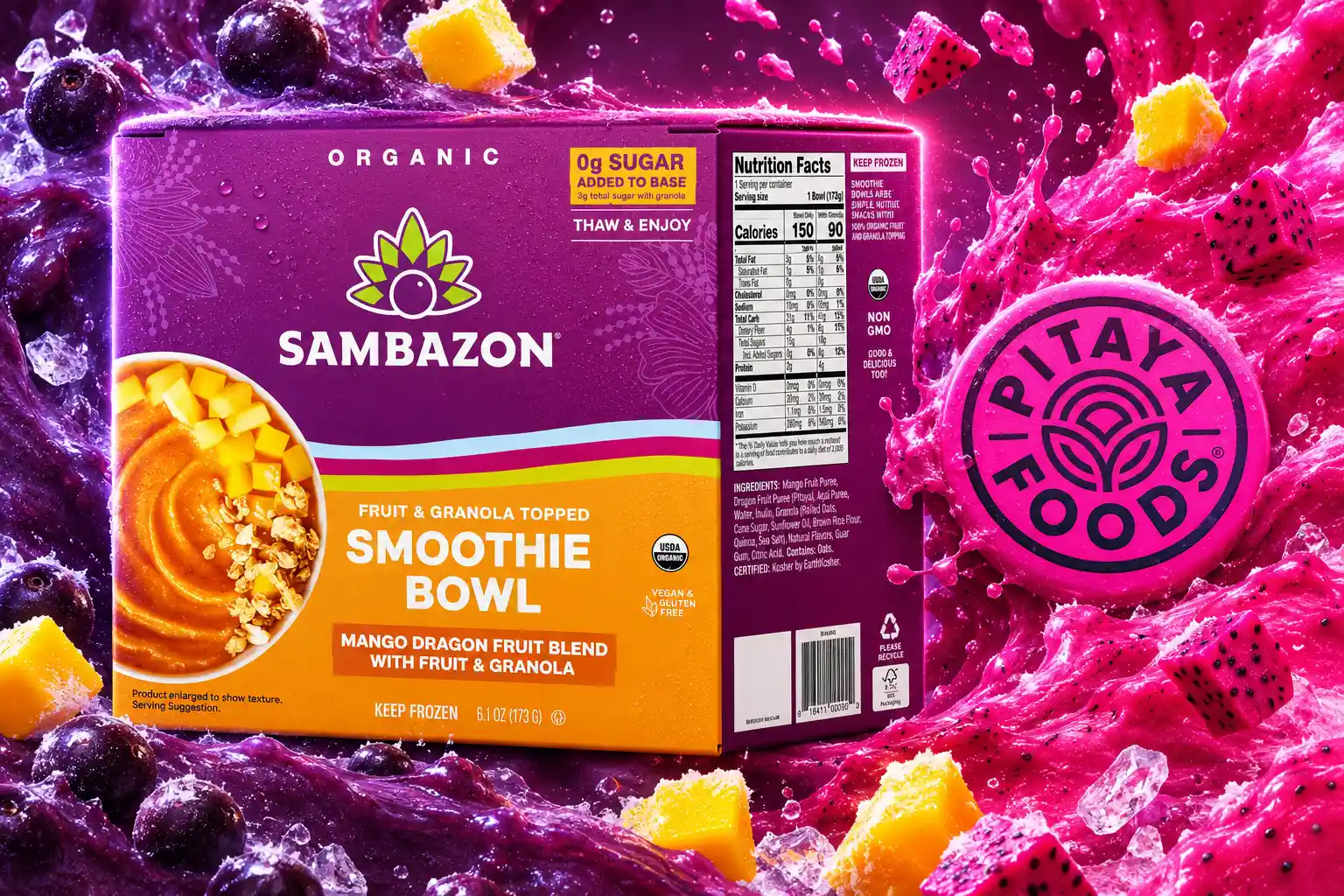
Pitaya’s Path From Nicaragua to Costco
Chuck Casano, Pitaya’s founder, was in Nicaragua in 2008 with a nonprofit when he ran into pitahaya, the fruit U.S. shoppers know as dragon fruit. The deal announcement dates the company to 2009. Co-founder Ben Hiddlestone joined in 2010 to help make the first organic dragon fruit product, and the first frozen shipment left Nicaragua that October.
They sold packs out of a Prius in California, then juice bars, then Whole Foods Market smoothie packs in 2013. Casano later said the freezer was split among one-fruit specialists: coconut kings, açaí kings, and Pitaya as the dragon fruit king. The company spent years adding jackfruit, avocado, watermelon, coconut, and açaí under one brand instead of hunting more of the same customers.
HOW THE TWO FRUIT BRANDS GOT HERE
- 2000: Sambazon is founded in California on wild-harvested Amazon açaí.
- 2009: Pitaya Foods is founded, per the deal announcement, after Casano’s Nicaragua posting.
- October 2010: First organic dragon fruit shipment leaves Nicaragua for the United States.
- 2017: Pitaya becomes a certified B Corp.
- March 8, 2024: Sambazon buys SunOpta’s frozen açaí and smoothie bowl business and adds U.S. production lines.
- April 21, 2025: Pitaya puts a Regenified organic frozen fruit line into Whole Foods Market nationwide.
- October 3, 2025: Sambazon raises $45 million in Series F-3 stock.
- November 10, 2026: Sambazon buys Pitaya Foods. Casano becomes executive vice president of sales.
By April 2025 the brand listed products in more than 15,000 retail stores and 5,000 foodservice outlets, including Whole Foods Market, Costco, Kroger, Target, Walmart, and Sprouts. It also said it had helped more than 1,000 farms reach USDA Organic status, created more than 200 jobs for single mothers in Nicaragua, and kept more than 600 hectares out of deforestation. Most Pitaya staff will join the combined company.
Why Sambazon Bought a Rival It Already Knew
Black said his team had known Casano for about a decade. Building a matching tropical-fruit line from scratch, he said, would have taken years, with Pitaya as a hard competitor the whole way. Sambazon had already sold a dragon fruit smoothie bowl as its first non-açaí bowl. It did not need a tutorial on the fruit. It needed Pitaya’s store count, farm list, and sales bench.
Building what they have created from scratch would have taken years to accomplish and with them as a formidable competitor every step of the way. While this may have been an option, a partnership to integrate the businesses and invest in the combined platform made much more sense, leveraging strength on strength.
Ryan Black, co-founder and CEO of Sambazon
Black also said Sambazon spent 26 years on açaí while Pitaya built a broader frozen-fruit mix, and that the two can now support the same shoppers and partners. The smoothie aisle, on that logic, pays more for a tropical set than for another single-fruit brand. Buying the rival is faster than outrunning it.
SunOpta’s Bowl Lines Gave Sambazon a U.S. Factory
On March 8, 2024, Sambazon bought SunOpta’s frozen açaí and smoothie bowl business. The company said the lines doubled its ready-to-eat bowl capacity and added U.S. manufacturing to two plants it already ran in Brazil, near harvesters. Ricardo Perdigao, then global chief financial officer and chief operating officer, called it a way to spread sustainably sourced superfoods through a wider bowl business. S&P Capital IQ put that bowls purchase at about $6 million.
SunOpta had already sold a wider frozen-fruit book to Nature’s Touch, a Canadian supplier. The breakup left a private-label specialist with bulk fruit and an açaí brand with bowl factories. Two years later Sambazon is stacking a second branded freezer name onto those lines. The 2024 buy made more bowls. The 2026 buy is meant to fill more doors with more SKUs.
Sambazon still processes açaí in the Amazon and sells in more than 50 countries. Its July 2026 impact report said it had bought 750 million pounds of certified organic, Fair Trade açaí over 25 years from 4,007 harvesting families, working with 1,159 harvesters across 350 communities in 2025, and had put more than $1.9 million through its Fair Trade Fund. That supply chain is the açaí side of the freezer. Pitaya is the rest of the case.
Most Frozen Fruit Already Wears a Store Brand
Sambazon’s own statement put frozen fruit unit sales up 10.7% in September, against a 0.1% year-over-year drop in overall retail food and beverage units. The American Frozen Food Institute, using 210 Analytics, went further on the same month: frozen fruit dollars up 12.3%, units up 10.7%, volume up 8.5%. Frozen fruits and vegetables together did $827.4 million, with dollars up 6.4% and units up 5.1%. The whole frozen-food department was $6.9 billion, with units up 1.0%.
SEPTEMBER IN THE FROZEN FRUIT CASE
- Frozen fruit dollars: Up 12.3% in September 2026, per the American Frozen Food Institute.
- Frozen fruit units: Up 10.7% that month, the figure Sambazon also cited in the deal statement.
- 52-week backdrop: NielsenIQ Byzzer put frozen fruit and smoothies at $1.95 billion, up 4.5%, for the year to June 27, 2026.
- Store brands: Géraldine Pra, director of marketing and insights at Nature’s Touch, said private label holds more than 70% of that category, a share that keeps growing.
Those two 70% figures are not the same thing. Sambazon is aiming for nearly 70% of U.S. grocery stores. Store brands already hold more than 70% of frozen fruit itself. The branded organic fight is for the minority of the case that is still a name on the bag. A 45% company growth target has to come from stealing doors, stacking SKUs, and taking foodservice, because the category’s own 52-week rate was 4.5% and even the hot September unit print was 10.7%.
Regenified Fruit Already Sits at Whole Foods
The deal statement made regenerative sourcing the long-term direction and used the closing to announce a second badge. Sambazon said its açaí is now the first açaí to earn Regenerative Organic Certified status, tied to wild harvest from standing Amazon forest, its own processing plants, and direct work with family harvesters. In July 2026 the company had only said it intended to pursue that certification. By November 10 it presented the badge as earned.
Pitaya’s path was a different program. On April 21, 2025, it launched a Regenified frozen fruit line at Whole Foods Market nationwide, the first national frozen fruit brand on that standard, with regenerative organic strawberries, blueberries, and mangoes. Fruit came from more than 277 acres on three family farms, inside a Regenified network of more than 1.7 million acres, with a stated path toward 681 acres in Chile and Peru.
WHAT PITAYA ADDS TO AN AÇAÍ CASE
- Dragon fruit packs and pieces: The original frozen pitaya SKUs that built Costco and juice-bar distribution Casano spent a decade selling.
- Ready-to-eat bowls and pops: Five smoothie bowls from 2023, smoothie pops from September 2024, plus later swirl and protein bowls that sit next to Sambazon’s own bowl lines.
- Other frozen fruit: Avocado, jackfruit, coconut, and açaí chunks that turn a one-fruit buyer into a full-case vendor.
- Regenified berries and mango: A Whole Foods-only regenerative line Sambazon did not have to build, already on shelf since April 2025.
Salar Shemirani, CEO of Regenified, said at that 2025 launch that the program measures soil and ecosystem results over time. For grocery buyers, the badges are another reason to keep both brands on the planogram. For Sambazon, they are assets that arrived with the invoice.
Casano Stays On to Sell the Combined Case
Casano becomes executive vice president of sales. Black remains CEO. In the joint statement Casano said Pitaya was built so healthy products and a positive impact could go together, and that the two brands now join forces. He did not describe a shutdown of the Pitaya name. The commercial job is the tell: the founder who opened Whole Foods, Costco, and Walmart is being paid to keep selling, not to step aside.
Nicaraguan packing jobs and the farm list sit inside that sales pitch whether shoppers see them or not. So do Pitaya’s foodservice doors, the 5,000 juice bars and cafes that never showed up in the grocery-reach percentage. Black can call açaí the anchor and still need someone who knows how to place dragon fruit pops next to it.
The 45% figure will be judged on invoices, not on the press release. Frozen fruit is growing. Store brands already own most of it. Sambazon just paid, at an undisclosed price, to put a second branded door team on a factory network it bought in 2024. That is the deal. The fruit on the bag is the easy part.

Ken Urker’s Accidental Overdose Leaves His Finders Waiting

A Third Carrier Arrives as Hormuz Tankers Keep Burning

Shoe Prices Hit a Record as Flagship Pairs Stay Put

Nvidia’s First Call Without Huang Tests the Money Machine

Blake Griffin Says Oklahoma City Taxpayers Bought a Thunder Arena

Warsh Rejects Rate Guidance and Still Moves Markets

Davina McCall Reveals Cardiovascular Disease After Cholesterol Warnings

Dana-Farber Exits an MGB Medicare Advantage Network Early

NASA Launches the Roman Space Telescope’s Cosmic Bet

OpenAI’s Cyber Letter Puts the Defense Bill on Governments
-
 BUSINESS3 months ago
Warsh Rejects Rate Guidance and Still Moves Markets
-
 ENTERTAINMENT1 month ago
Davina McCall Reveals Cardiovascular Disease After Cholesterol Warnings
-
 BUSINESS2 months ago
Dana-Farber Exits an MGB Medicare Advantage Network Early
-
 NEWS3 months ago
NASA Launches the Roman Space Telescope’s Cosmic Bet
-
 NEWS3 months ago
OpenAI’s Cyber Letter Puts the Defense Bill on Governments
-

 NEWS3 months ago
Russia Recycles Its Old Warning Over Storm Shadow Plants
-

 ENTERTAINMENT2 months ago
Primetime’s $2.7 Million Preview Tops Pitt’s Costlier Film
-

 BUSINESS3 months ago
Jet Drones Lock Down Kyiv and Strip Kherson of Heat