
NEWS
Congo Starts Ervebo Vaccinations for a Different Ebola Virus
Congo is giving Ervebo, a Zaire Ebola vaccine, against Bundibugyo starting in Kisangani while a trial tests whether it works.

Congo began Ebola vaccinations on Aug. 28 in Kisangani, putting Ervebo into arms against Bundibugyo virus, a species the shot is not licensed to stop. Health Minister Samuel-Roger Kamba gave some of the first doses to health workers while government figures already stood at 5,713 confirmed cases and 2,744 deaths.
More than 50,000 doses had reached the country from the global stockpile. Another 20,000 are reserved for a Phase 3 trial that still has to show whether the vaccine protects people at all.
The First Jabs Went Into Kisangani
The launch was held in the Tshopo capital, one of six provinces now reporting Bundibugyo Ebola, not in Ituri, where the outbreak was declared on May 15 and where about 90% of confirmed infections have been recorded. Kamba said health workers would go first, then people who had close contact with patients, then a wider at-risk group if the early results hold.
We have decided to use the Ervebo vaccine to protect first those who are on the front line, therefore our health care providers, but also people who have been in contact with patients.
Samuel-Roger Kamba, Health Minister, Democratic Republic of the Congo, Kisangani launch
The campaign is meant to cover 14 health zones in Tshopo, Bas-Uele and Haut-Uele, provinces that were hit later than Ituri. Kamba described the path as a ring that would move toward the centre of the outbreak. Officials said more than 50,000 doses were already in country when the first syringes went in.
Confirmed cases have kept climbing since that Thursday. Local authorities put the tally at 6,041 confirmed infections and 2,911 deaths as of Aug. 31, with a case fatality rate near 48%. The World Health Organization has said the epidemic remains out of control and is on course to pass the 2014 to 2016 West Africa outbreak, which killed more than 11,000 people.
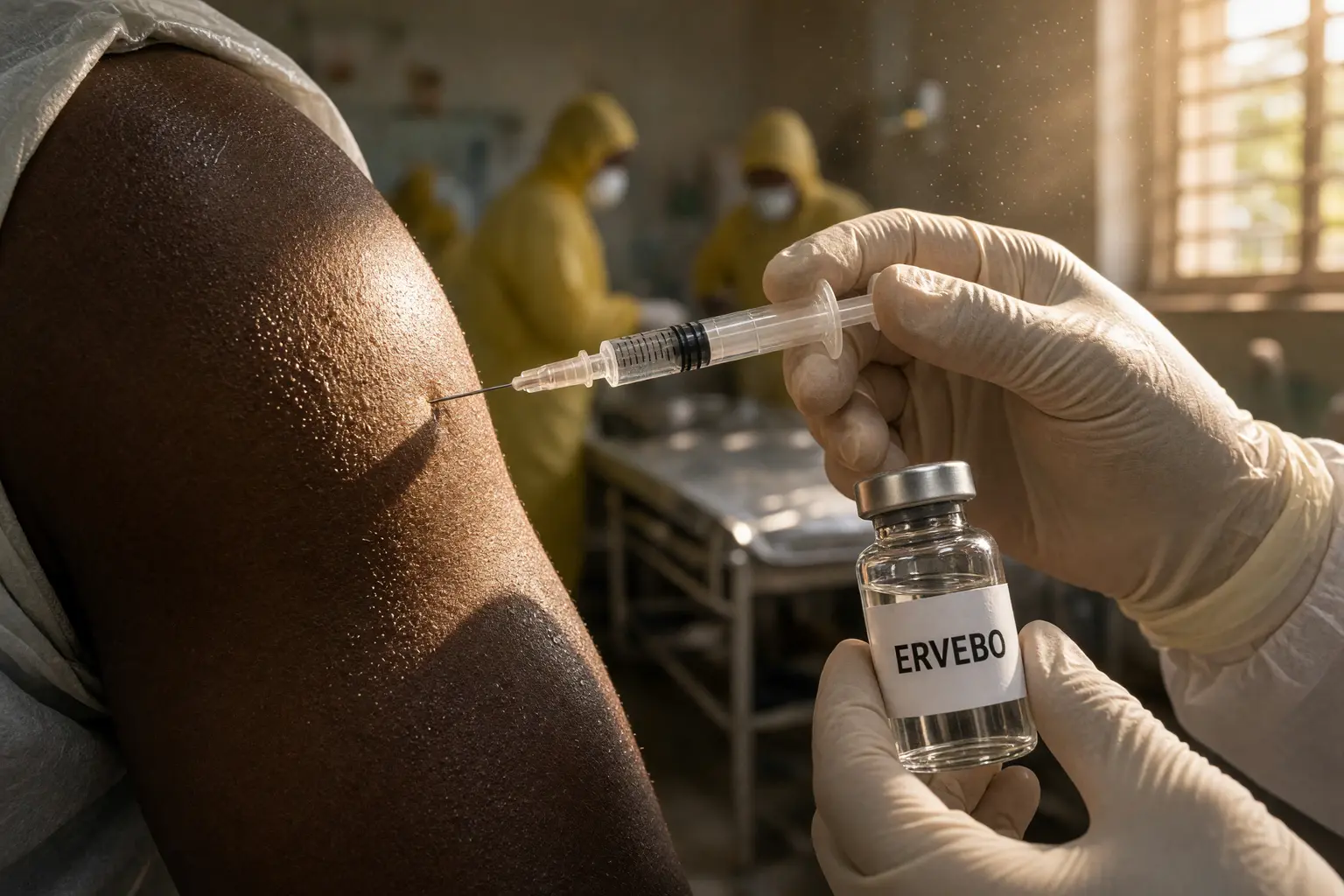
Ervebo Was Licensed for Zaire Ebola
Ervebo is a single-dose vesicular stomatitis virus vaccine that displays the surface protein of Zaire ebolavirus, the species behind most of Congo’s past 17 outbreaks. The U.S. Food and Drug Administration authorized it in 2019 for prevention of Ebola Zaire from age 12. Effectiveness against that species is estimated at 84%. It has no license for Bundibugyo virus disease, and no licensed treatment exists for this outbreak either.
The two viruses sit in the same genus, but their genomes differ by about 30% at the nucleotide level, and the amino acids in their surface proteins can differ by up to 40%. That gap is why a shot built for Zaire cannot be assumed to stop Bundibugyo. Congo still asked the International Coordinating Group on Vaccine Provision to open the Gavi-funded stockpile, and the ICG answered with an immediate initial release of 70,000 doses.
The Democratic Republic of the Congo (#DRC) will receive Ervebo vaccines from the global Ebola virus disease vaccine stockpile for use in the current Bundibugyo virus disease outbreak.
The Ervebo vaccine is licensed and recommended for use in outbreaks of Ebola virus (previously… pic.twitter.com/LKg3GlAaO9
— World Health Organization (WHO) (@WHO) August 20, 2026
HOW THE 70,000 DOSES WERE SPLIT
| Use | Doses | Status |
|---|---|---|
| Front-line and health workers | 50,000 | Compassionate use, with informed consent |
| Phase 3 ring trial | 20,000 | Tests whether Ervebo protects against Bundibugyo |
| Already received at launch | More than 50,000 | On hand in Congo on Aug. 28 |
Gavi, which funds the stockpile, said it would provide $7 million to fund the shipment and another $6 million for vaccination work in high-risk areas. Gavi chief executive Sania Nishtar said this is already the largest Ebola outbreak in Congo’s history and could become the largest ever. From 2021 through July, the ICG had allocated more than 56,000 Ervebo doses to Zaire outbreaks in Congo, plus 167,000 doses used in preventive campaigns for health and front-line workers in Congo, Guinea-Bissau, Kenya, Sierra Leone and Uganda.
Those earlier shipments matched the virus they were built for. This one does not. WHO said it is not known whether Ervebo may be protective against Bundibugyo virus in humans, though early laboratory and animal data suggest some protection, and that everyone offered the shot, in the trial and otherwise, must hear the limits and be able to consent.
Three of Four Vaccinated Monkeys Lived
In late May, a WHO expert panel judged the cross-protection evidence too weak to try Ervebo at all, warning that a mismatched shot could create a false sense of safety and, if vaccinated people still fell ill, damage trust in Ebola vaccination. By July 31 that panel was looking at a different file. Myron Levine, a University of Maryland vaccinologist who chairs the group, said everybody on the call was surprised by the data. All but one member then voted to back a Phase 3 trial in Congo.
THE CROSS-PROTECTION FILE
| Study type | What was measured | Result cited to the panel |
|---|---|---|
| Human blood after Ervebo | Antibodies that bind Bundibugyo | Three separate studies found binding antibodies, weaker than the response to Zaire |
| Ferrets | Survival after Bundibugyo infection | Vaccinated animals lived; unvaccinated controls died within 10 days |
| Monkeys | Survival after Bundibugyo challenge | Three of four vaccinated animals survived, versus one of four controls |
Levine later said the very limited data argue that, in this kind of situation, you go for it, but in a way that still gathers information about whether the vaccine works. Placide Mbala, who leads epidemiology at Congo’s National Institute of Biomedical Research and directs research and clinical trials at Africa CDC, put the public-health case more sharply.
If this vaccine can provide at least some protection and reduce drastically the number of new cases and deaths, why should we not use it. No scientific question or clinical trial can justify delaying public health action which can save at least one life.
Placide Mbala, Africa CDC / INRB, comments to Science
Africa CDC and the Congolese government announced support on Aug. 10 for an immediate, broader rollout, a step that could pull people away from a placebo-controlled trial. An Africa CDC spokesperson said the agency was not dropping the efficacy study and was backing Congo on two tracks at once.
Why the Campaign Is Skipping Ituri
Ituri still holds the centre of the outbreak, and North Kivu has posted a higher fatality share among the cases it does have. Kisangani sits on the Congo River, hours from Bunia, with a functioning airport and a treatment centre that has seen far less of the virus. Starting there is slower as outbreak control and easier as logistics.
WHAT IS HOLDING THE SHOTS BACK FROM THE EPICENTER
- The caseload: Ituri has accounted for about 90% of confirmed infections since mid-May, with the virus in most of the province’s health zones.
- The security map: Armed conflict, illegal mining and displacement have made contact tracing incomplete, and patient zero has not been identified.
- The payroll fight: Health workers in Bunia, Rwampara, Mongbwalu and other Ituri sites have walked out, in short bursts, over wages unpaid since the outbreak was declared.
- The ring plan: Kamba said teams will cover provinces around Ituri first and move toward the centre once that outer belt is vaccinated.
The same conditions that make Ituri the deadliest province also make it a hard place to run a first-of-its-kind off-label campaign. Intense population movement across six provinces, a health workers’ strike, and attacks on clinics have already stretched surveillance. Julien Harneis, the senior U.N. Ebola coordinator, said in late August that the epidemic was expanding exponentially across an area larger than France, and that the existing pool of funds would run out within weeks.
Unpaid Workers Get the First Doses
The people now first in line for Ervebo are the same crews who have spent the summer treating patients without a licensed drug, and often without pay. WHO said in July that more than 100 health-care workers had been infected. Strikes hit Bunia General Hospital, Rwampara, the Elikya treatment centre and, by mid-August, staff in Kisangani, who warned they would shut the site if wages did not arrive.
Wiza Bondele, a 29-year-old infection-control worker in Ituri, said he had been on duty without the monthly salary of $510 he was promised. Martin Bolombi, a hygiene worker at Elikya, said in August he had been working since May and had been paid only for June. Communications minister Patrick Muyaya Katembwe said delayed payments had triggered protests and that outstanding sums were being processed. Dr. Adelard Lufungula, operations manager for the government response, said workers were being shifted to mobile-money payments and that the backlog should clear.
The government had acknowledged embezzlement of response funds. Sporadic strikes have so far lasted only a few days, but they have closed hospital gates while patients were still inside. Reena Doshi, a WHO epidemiologist in Nairobi, asked the question hanging over every first dose in Kisangani: what happens if you vaccinate health-care workers with Ervebo and then people start getting sick? Nobody is going to want the vaccine then.
That risk is already visible in the noisier public argument, where a Zaire shot used against Bundibugyo is read as a product in search of a market rather than as an emergency stopgap. If vaccinated nurses still fall ill, the next Bundibugyo-specific candidate will inherit that distrust.
Half of Each Ring Gets Placebo
WHO wants the human evidence from a ring vaccination trial, the same design that showed Ervebo worked against Zaire in Guinea in 2015. People who had contact with a confirmed case would be enrolled; half of each ring would receive Ervebo and the other half a placebo. Ira Longini, a University of Florida biostatistician who helped design the WHO trial, said Ervebo may provide hardly any protection against Bundibugyo, or it could be a great vaccine for all Ebola viruses, but only randomized trials can tell. If we start just using it on everyone, he said, we are not going to learn what we need to know.
Médecins Sans Frontières took the other side. Armand Sprecher, a public-health specialist at MSF, said Bundibugyo-specific vaccines were moving so fast that a placebo arm could soon be answering a question nobody would care about for long. MSF, with Congo and Africa CDC, designed a separate study called BRAVO that would vaccinate front-line workers with Ervebo, later boost some with an experimental Sudan-virus shot, and then compare vaccination status among people who test positive or negative at treatment centres. Sprecher said the primary objective is to get as many people vaccinated as we can.
HOW THE WAGER WAS PLACED
- May 15, 2026: Congo declares a Bundibugyo Ebola outbreak in Ituri.
- May 28, 2026: WHO emergency guidance finds the Ervebo cross-protection evidence too weak for use.
- July 31, 2026: The candidate-vaccine panel reviews new animal and antibody data and backs a Phase 3 ring trial.
- Aug. 7, 2026: Tedros Adhanom Ghebreyesus says WHO is working with partners to start that trial as soon as possible.
- Aug. 10, 2026: Africa CDC and Congo announce support for a broader immediate rollout.
- Aug. 13 to 17, 2026: Congo requests ICG doses; ICG asks SAGE and the research group for advice, then releases 20,000 trial doses and 50,000 for health workers.
- Aug. 28, 2026: Kamba opens the campaign in Kisangani.
- Aug. 31, 2026: Updated WHO guidance still says evidence is insufficient to know whether Ervebo gives meaningful protection in humans and recommends that programs use Ervebo only within research protocols.
The shots in Kisangani therefore began three days before WHO published that tighter line. SAGE had already allowed 50,000 doses for front-line workers in line with its existing recommendations, provided people were told the efficacy against Bundibugyo is unknown. Charlie Weller, head of vaccines at the Wellcome Trust, which funded Ervebo’s early development, said African leaders had reviewed the evidence, including their population needs, and decided there was enough safety and efficacy to roll the vaccine out.
Oxford and Moderna Shots Are Close
Two Bundibugyo-specific candidates have started Phase 1 safety trials in Canada and the United Kingdom. Teresa Lambe, an Oxford vaccinologist, said a chimpanzee-adenovirus shot from her group could be ready for an efficacy study as early as September. A Moderna messenger-RNA candidate is not far behind. IAVI has another program. CEPI had already added funds to accelerate Oxford and IAVI work in the first weeks of the outbreak. WHO’s August guidance still urges speed on those species-matched products, because Ervebo was never meant to be the last word on Bundibugyo.
WHERE EXPERTS DISAGREE
- Ira Longini: Only a randomized ring trial can show whether Ervebo works against Bundibugyo; vaccinating everyone first would erase the answer.
- Armand Sprecher: A placebo arm is hard to justify if matched vaccines may arrive within weeks; BRAVO is built to get doses into workers now.
- Placide Mbala: A trial cannot justify delay if even partial protection would cut deaths in an outbreak already past 6,000 confirmed cases.
Bundibugyo virus was identified in Uganda in 2007, in an outbreak of 131 cases and 42 deaths. A second outbreak in Congo in 2012 was counted at 62 cases and 34 deaths in a 2026 review, though some tallies list only 38 laboratory-confirmed infections. Those numbers never built a market. The 2026 epidemic is the first time the virus has moved at this scale, and Congo is answering with a stockpile built for a cousin species, a river-city launch far from most of the graves, and a workforce still chasing last month’s pay.
Classes resumed in Ituri on Sept. 1. The first Ervebo doses remain in Tshopo, Bas-Uele and Haut-Uele, the belt Kamba said would be vaccinated before teams push into the province that still holds most of the dead.
Disclaimer: This article is news reporting and analysis of an unfolding outbreak and vaccination campaign, and it is for information only. It is not medical advice, not a recommendation to seek or refuse Ervebo or any other shot, and not guidance on diagnosis or treatment of Ebola virus disease. Readers who may have been exposed, who work in an affected health zone, or who are offered vaccination should consult a qualified physician or the health authority running the local response before making any decision. Case counts, dose allocations, trial designs and official guidance reflect the sources as of Sept. 2, 2026, and can change as the outbreak and the studies move.


Iran Pulls Oman Into a Hormuz Revenue Bargain

Lin Throws Out the Anthropic Blacklist, Keeps Vendor Choice

Congo Starts Ervebo Vaccinations for a Different Ebola Virus

The Army Laser Downs Cartel Drones After a Messy Spring

NASA Launches the Roman Space Telescope’s Cosmic Bet

Russia Recycles Its Old Warning Over Storm Shadow Plants

Jet Drones Lock Down Kyiv and Strip Kherson of Heat
NASA Launches the Roman Space Telescope’s Cosmic Bet

Record Cyclospora Outbreak Follows Seven Years Without an Inspection

OpenAI’s Cyber Letter Puts the Defense Bill on Governments
-
 NEWS5 days ago
Russia Recycles Its Old Warning Over Storm Shadow Plants
-
 BUSINESS5 days ago
Jet Drones Lock Down Kyiv and Strip Kherson of Heat
-
 NEWS5 days ago
NASA Launches the Roman Space Telescope’s Cosmic Bet
-
 NEWS5 days ago
Record Cyclospora Outbreak Follows Seven Years Without an Inspection
-
 NEWS5 days ago
OpenAI’s Cyber Letter Puts the Defense Bill on Governments
-

 BUSINESS5 days ago
Warsh Rejects Rate Guidance and Still Moves Markets
-
 NEWS4 days ago
Lin Throws Out the Anthropic Blacklist, Keeps Vendor Choice
-
 BUSINESS4 days ago
Iran Pulls Oman Into a Hormuz Revenue Bargain