
BUSINESS
Warsh’s Jackson Hole Speech Leaves the Rate Call to Others
Kevin Warsh’s first Jackson Hole speech is set to skip rate hints, leaving a 3.7 percent inflation print, three hawks.

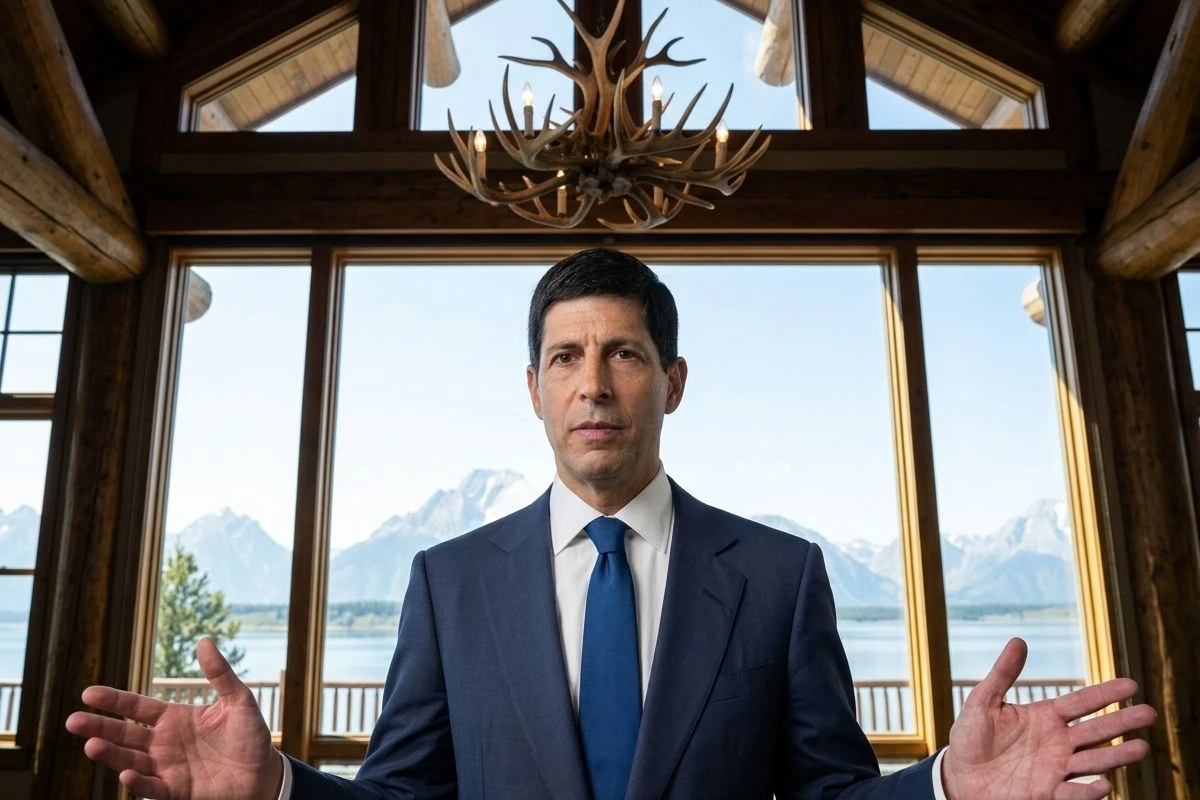
Kevin Warsh delivers his first Jackson Hole keynote Friday at 10 a.m. Eastern, with no questions allowed. The Kansas City Fed listed him for opening remarks at 8 a.m. Mountain. The printed program is about payments and tokenized finance, not the path of the federal funds rate.
Markets still came for a rate hint he has spent three months refusing to give. By Thursday night that hint was already in the building, just not in his mouth.
Friday’s Program Starts With Tokenized Finance
The Federal Reserve Bank of Kansas City titled this year’s gathering “Financial Innovation, Implications for Payments and Policy.” Warsh’s slot is the first paper of the Friday session, chaired by MIT’s Kristin J. Forbes, and the Fed Board schedule says the text will be posted as he speaks. There is no Q&A.
The Kansas City Fed is streaming the remarks live. The rest of the day is academic plumbing, not a rates seminar.
That mismatch is the whole setup. Trading desks still treat the Wyoming meeting as the one morning a chair tells them whether the next move is up or down. The chair’s host bank wrote a different schedule.
FRIDAY’S ACTUAL RUNNING ORDER
- 8:00 a.m. Mountain: Warsh opens; video remarks go up on the Kansas City Fed YouTube page as he talks.
- 8:30 a.m.: Cornell’s Eswar Prasad presents on financial innovation and the international monetary system, with the Bank of England’s Catherine L. Mann as discussant.
- 9:55 a.m.: Stanford’s Darrell Duffie presents on innovation in tokenized finance, with the ECB’s Isabel Schnabel as discussant.
- 10:55 a.m.: A payments panel with the BIS, the OECD, and IMF Managing Director Kristalina Georgieva.
- 1:00 p.m.: Harvard’s Kenneth Rogoff gives the luncheon address.
The Kansas City Fed says around 120 people typically attend, with press kept small so the room can still argue. Saturday continues on banking and the financing of innovation. None of those papers is a substitute for a funds-rate forecast, and Warsh has given every sign he will not supply one in the time reserved for “opening remarks.”
@Federalreserve Chairman Kevin Warsh will deliver the opening remarks at the Jackson Hole Economic Symposium on Aug. 28 at 8 a.m. (10 a.m. EDT). Watch live on our YouTube page: https://t.co/jAbrxCZ175
Read more on the symposium here: https://t.co/r3FXgcIyZp#JacksonHole2026 pic.twitter.com/P5O7DvQPq9
— Kansas City Fed (@KansasCityFed) August 25, 2026
Three Presidents Spoke Before the Chairman Did
The rate conversation started on the sidelines Thursday, while Warsh was still a day from the lectern. Kansas City Fed President Jeffrey Schmid, Chicago Fed President Austan Goolsbee, and Cleveland Fed President Beth Hammack each used interviews to say inflation remains too high. Reuters put those comments on the wire before the Friday session began.
Schmid, the host president, told CNBC that inflation is “still stubborn and it’s still sticky and we’ve got to continue to find ways to break through.” He then asked the question that actually moved the tape: he did not know what the current rate policy was restricting. The policy rate has sat in a 3.50% to 3.75% range since the committee held it there in July.
Hammack had already dissented in favor of a hike at the July 28-29 meeting, alongside Minneapolis Fed President Neel Kashkari and Dallas Fed President Lorie Logan. On CNBC she went further than a dissent footnote.
| Official | Thursday line | July 29 vote |
|---|---|---|
| Jeffrey Schmid, Kansas City Fed president | Called inflation stubborn and sticky; questioned whether 3.50% to 3.75% restricts demand | Not among the three hikers |
| Beth Hammack, Cleveland Fed president | “I believe now is the time to act”; sees no restriction in financial conditions | Dissented for a 25-basis-point hike |
| Austan Goolsbee, Chicago Fed president | “Everybody should be on edge”; biggest near-term fear is inflation still not under control | Not among the three hikers |
Hammack forecast inflation ending this year around 3% and making it only to the mid-twos next year “at best.” She said she had met workers in Erie, Pennsylvania, who hold good jobs and still cannot afford an ice cream cone on the weekend with their kids. Goolsbee, on the Rapid Response podcast, pointed to energy costs tied to the Iran conflict and to the back-and-forth on tariffs, then added that the recent three-month inflation trend “doesn’t look terrible.”
Warsh has said he wants a “family fight” inside the committee and has refused to pre-announce the winner. Thursday showed what that fight looks like in public. When the chair will not sketch a path, regional presidents fill the airtime, and they do not all read the same forecast.
What a Reaction Function Is
A reaction function is the bank’s own account of what it watches, how it reads the economy, how it weighs risks, and what would change its mind. The Brookings Institution used that definition in an analysis last month, and Warsh has declined to offer one when reporters ask. Forward guidance is the more explicit cousin: a projected rate path if the economy evolves as expected. He has dropped that too.
The Associated Press reported that the June policy statement was cut to 132 words from 341 words in April, and that Warsh skipped filing his own projection in the quarterly forecasts. After the June meeting he said forward guidance is not the business the Fed should be in. At the ECB’s Sintra forum on July 1 he told a moderator trying to extract a September hint that she was “trying to get me to break this rule” and that she was going to fail.
He has been blunt about the target and silent about the tactic. “We’re in the price stability business,” he said at Sintra, adding that people who thought the committee would be comfortable above 2% would be disappointed. Reuters notes the Fed has now missed that 2% target for 65 straight months. After the July meeting he described the replacement for a guided path in one sentence about prices, not about adjectives in a statement.
Letting buyers and sellers meet at prices for Treasuries, for the foreign exchange value of the dollar, and then trying to judge for ourselves, what does that mean about our remit?
Kevin Warsh, Federal Reserve chairman, July 29 press conference
Jan Groen, chief U.S. economist at Societe Generale, told CNN he does not expect any signals out of Friday’s speech, and that if he is right the market is not going to like it. Ian Kresnak, a senior investment strategist at Vanguard, said the opposite of Warsh’s Sintra claim: the bond market is looking to the Fed for clues on the reaction function, and uncertainty about the inflation response is driving a lot of the vol in rates. A CNBC survey of 31 economists, strategists, and investors this week found that 80% want Warsh to explain his economic views in more detail. Glenmede investors, in an August 24 note, called Jackson Hole his best room in which to do it.
David Wilcox, a senior fellow at the Peterson Institute for International Economics, argued he can clarify a conceptual framework without tipping the next vote. David Andolfatto, quoted by the AP in June, put the same objection more sharply: dropping forward guidance is fine, but it has to be replaced with a contingency plan, and “trust me” is not that plan. Warsh’s bet is that the contingency plan is the Treasury market itself.
The Long End Tightened Without a Vote
That bet is already showing up in prices. After Warsh’s July press conference, long-term yields jumped, which CNN read as traders worrying the Fed would not do enough into sticky inflation. The funds rate did not move. The 10-year and the 30-year did.
The Commerce Department said the personal consumption expenditures price index, the Fed’s main inflation gauge, rose 3.7% in the 12 months through July, matching June and down from 4.1% in May. The monthly gain was 0.2%, a tick above the 0.1% Reuters poll. Headline CPI for July was 3.4%, with core CPI at 2.5%. Reuters, from Jackson Hole, cited auto prices running at a roughly 5% annualized pace in July, housing and utilities above 3.5%, and recreational goods at a double-digit pace.
The policy rate is still 3.50% to 3.75%. July payrolls fell 23,000. Second-quarter GDP was revised to 1.5%, unchanged from the first print. Jim Caron, chief investment officer of portfolio solutions at Morgan Stanley Wealth Management, called it a close call whether they hike at all this year. The committee can hold the overnight rate and still watch 30-year yields do a version of the hike for it, which is the second-order result of saying less.
WHERE THE NUMBERS SAT THIS WEEK
- Inflation: July PCE at 3.7% year over year, the same as June, nearly double the 2% target.
- Policy rate: Held at 3.50% to 3.75% on July 29, with three dissents for a hike.
- Long yields: The 10-year recently around 4.69% to 4.74%; the 30-year recently above 5.3%, levels not seen since 2007.
- September meeting: CME FedWatch, as cited by Reuters on Wednesday, put a 40.1% chance on at least 25 basis points of tightening after the PCE print; CNN had the figure at roughly 34% in its preview.
Corporate bond supply and AI-buildout borrowing have also been pushing term premium higher, alongside the government’s own issuance. Warsh launched five task forces on communications, the balance sheet, data, AI’s effect on productivity and jobs, and inflation frameworks. Those reviews may eventually change how the committee talks. They do not lower the 30-year this week.
Bessent’s Buyback Meets a $40 Trillion Ledger
The other actor in this rates drama does not sit on the FOMC. Treasury Secretary Scott Bessent announced last week that the department would at least double longer-dated buybacks, from $2 billion per operation to at least $4 billion, starting September 9 and running through November 4 in the 10-to-20-year and 20-to-30-year sectors. He told CNBC the size “could be more than the $4 billion per issue.”
The U.S. Treasury’s Debt to the Penny ledger shows total public debt of $40.07 trillion as of August 26, or $40,069,751,423,220.72, with $32.31 trillion held by the public. The total crossed the $40 trillion line around August 18-19. Bessent told CNBC’s Sara Eisen, “There’s nothing magic about the 40-trillion number,” and that “we can grow our way out of that.” The 30-year yield fell on the buyback headline, then retraced as the week wore on.
HOW THE SILENCE AND THE DEBT COLLIDED
- May 22, 2026: Warsh is sworn in as chair and inherits a funds rate at 3.50% to 3.75%.
- June 17, 2026: First FOMC under Warsh holds rates, shortens the statement, and drops forward-guidance language.
- July 1, 2026: At Sintra he repeats the 2% vow and refuses a rate hint.
- July 28-29, 2026: The committee holds again; Hammack, Kashkari, and Logan dissent for a hike; long yields jump after the press conference.
- August 19-20, 2026: Debt crosses $40 trillion; Bessent doubles long-end buybacks and says they can run larger still.
- August 27, 2026: Schmid, Hammack, and Goolsbee warn on inflation on the first day in Wyoming.
- August 28, 2026: Warsh’s keynote, text posted, no Q&A.
Higher long yields raise the cost of rolling that public debt. A chair who will not cap them with words leaves the Treasury to cap them with cash, or try to. Bessent said auctions of new 10-year, 20-year, and 30-year securities will continue as scheduled, with the next long sales due in mid-September, which is also when the larger buybacks begin. The two desks are now conducting different experiments on the same curve.
Jackson Hole Trained Markets to Wait
For more than two decades the sitting Fed leader has used this podium to hint where rates are going. Jerome Powell’s August 2022 remarks were the modern template: a short, narrow, direct speech that warned of “some pain to households and businesses” and of keeping a restrictive stance “for some time.” Stocks sold off. The committee then delivered more large hikes and took the funds rate to 5.25% to 5.50% by July 2023, the last increase before the current pause.
Powell used the same stage in 2021 to argue that a battered labor market still needed support, and in 2024 to walk through the disinflation that followed. Reuters, previewing his last turn in 2025, treated the walk through the Jackson Lake Lodge lobby, past the stuffed grizzly and the elk-antler lights, as the annual rates ritual. Warsh is breaking the ritual on purpose. He has argued that markets got too hooked on being told the answer, and that guidance works better in a crash than in a messy expansion.
The hook is still there. Desk notes this week still framed Friday as hawkish, dovish, or a cop-out, the same three boxes used for Powell. Crypto accounts sold a crash-or-pump binary off the 2022 pain speech and a 2025 bounce, even though this year’s papers are about tokenized finance and stablecoin plumbing. The loudest of those warnings got called out in their own threads as recycled. A quiet speech is the one outcome the binary cannot price cleanly, which is why Groen thinks a no-signal morning will not go down well, and why Warsh keeps choosing it.
A Coin-Flip Bet on the September Meeting
The next vote is September 15-16, 19 days on the FedWatch countdown. Reuters, after Wednesday’s PCE report, said CME FedWatch had September hike odds in fed funds futures at 40.1%, up from about 36% before the release. CNN’s later preview put the chance at roughly 34%. Later meetings still show a higher chance of a hike than September does. No one on the committee, in the July record, was arguing for a cut.
President Donald Trump has kept calling for lower rates. Warsh, at Sintra, said the Fed has been independent a very long time, will be independent at this moment, and that “you’re going to see no changes on that.” He also said inflation is a choice, and that this committee had unanimously decided to deliver on it. Tactics, he added, were still to come.
Friday morning is not the tactics memo the 80% in the CNBC survey asked for. It is the test of whether he can keep the tactics off the podium while Schmid, Hammack, Goolsbee, a 3.7% PCE print, and a Treasury buyback keep writing them in public. The prepared text will sit on the Kansas City Fed site as soon as he reads it. The September decision will not.
Disclaimer: This article is news reporting and analysis of Federal Reserve communications, inflation data, and market pricing, and it is for information only. It is not investment advice, a recommendation to buy or sell Treasuries, stocks, or any other security, and it is not a forecast of the federal funds rate or of bond yields. Readers should consult a licensed financial adviser or investment professional before making portfolio or borrowing decisions. Figures for inflation, yields, public debt, and CME FedWatch probabilities reflect the sources as of August 28, 2026, and will change as new data, speeches, and meeting outcomes arrive.


Iran’s Hormuz Terms Put Oman in a Revenue Bind

Anthropic Beats the Blacklist as Rivals Keep Pentagon Work

NASA Flies Surplus Spy Optics on the Roman Telescope

Russia Threatens UK Military Sites Over New Missile Plants

AI Labs Want Public Money After Their Models Broke Out

Russian Jet Drones Steal a Workday From Kyiv
AI Labs Want Public Money After Their Models Broke Out
Iran’s Hormuz Terms Put Oman in a Revenue Bind

Cyclospora Lettuce Outbreak Hits 20 States After Inspection Gap
Russia Threatens UK Military Sites Over New Missile Plants
-
 BUSINESS2 days ago
Russian Jet Drones Steal a Workday From Kyiv
-
 NEWS2 days ago
AI Labs Want Public Money After Their Models Broke Out
-
 BUSINESS1 day ago
Iran’s Hormuz Terms Put Oman in a Revenue Bind
-
 NEWS2 days ago
Cyclospora Lettuce Outbreak Hits 20 States After Inspection Gap
-
 NEWS1 day ago
Russia Threatens UK Military Sites Over New Missile Plants
-
 NEWS1 day ago
Anthropic Beats the Blacklist as Rivals Keep Pentagon Work